Ch.6 - Electronic Structure of Atoms
Brown - Chemistry: The Central Science 14th Edition
Brown14th EditionChemistry: The Central ScienceISBN: 9780134414232당신이 사용하는 게 아니라요?교과서 변경
6장, 문제 66a

(a) With reference to Figure 6.19, what is the relationship between the number of nodes in an s orbital and the value of the principal quantum number?
Graphs showing probability distributions for 1s, 2s, and 3s orbitals with nodes indicated.

검증된 단계별 안내
1
Examine the provided graphs for the 1s, 2s, and 3s orbitals, noting the number of nodes in each.
Identify that the 1s orbital has 0 nodes, the 2s orbital has 1 node, and the 3s orbital has 2 nodes.
Recall that the principal quantum number (n) represents the energy level of the orbital.
Understand that the number of nodes in an s orbital is given by the formula: number of nodes = n - 1.
Conclude that as the principal quantum number (n) increases, the number of nodes in the s orbital also increases according to the relationship: number of nodes = n - 1.

비슷한 문제에 대한 검증된 영상 답변:

이 영상 해법은 위 문제에 도움이 된다고 튜터들이 추천한 것입니다.
영상 길이:
1m

주요 개념

질문에 올바르게 답하기 위해 반드시 이해해야 하는 핵심 개념들은 다음과 같습니다.

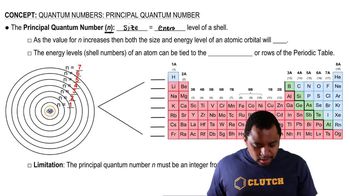
Principal Quantum Number (n)

The principal quantum number (n) indicates the energy level of an electron in an atom and is a positive integer (1, 2, 3, ...). As n increases, the electron's average distance from the nucleus increases, leading to higher energy levels. Each value of n corresponds to a different electron shell, with higher n values allowing for more complex orbital shapes and sizes.
추천 영상:
가이드 코스
02:55
Principal Quantum Number

Nodes in Orbitals

Nodes are regions in an atomic orbital where the probability of finding an electron is zero. The number of nodes in an orbital is directly related to the principal quantum number; specifically, the number of nodes increases as n increases. For s orbitals, the number of nodes is given by the formula n-1, meaning that a 1s orbital has no nodes, a 2s has one node, and a 3s has two nodes.
추천 영상:
가이드 코스
00:38
Radial Nodes Example

s Orbitals

s orbitals are spherical in shape and are characterized by their principal quantum number. Each s orbital can hold a maximum of two electrons and has a specific number of nodes based on its n value. The graphical representation of s orbitals shows how the probability of finding an electron varies with distance from the nucleus, highlighting the presence of nodes as the principal quantum number increases.
추천 영상:
가이드 코스
03:06
Molecular Orbital Theory