(d) For the hydrogen atom, list the following orbitals in order of increasing energy (that is, most stable ones first): 4f, 6s, 3d, 1s, 2p.
Ch.6 - Electronic Structure of Atoms
6장, 문제 66d
(d) For the hydrogen atom, list the following orbitals in order of increasing energy: 3s, 2s, 2p, 5s, 4d.
검증된 단계별 안내1
Identify the principal quantum number (n) for each orbital, which indicates the energy level. For example, in the 3s orbital, n=3.
Recognize that for a hydrogen atom, the energy of an orbital primarily depends on the principal quantum number (n). Orbitals with a lower n value have lower energy.
Arrange the orbitals by their principal quantum number (n) in ascending order. If two orbitals have the same n value, they have the same energy in a hydrogen atom.
List the orbitals in order from the lowest n value to the highest n value. Since all orbitals with the same n value have the same energy in hydrogen, they can be listed in any order within the same n value.
Final order from lowest to highest energy for the hydrogen atom will be: 2s, 2p, 3s, 4d, 5s.

비슷한 문제에 대한 검증된 영상 답변:
이 영상 해법은 위 문제에 도움이 된다고 튜터들이 추천한 것입니다.
영상 길이:
6m주요 개념
질문에 올바르게 답하기 위해 반드시 이해해야 하는 핵심 개념들은 다음과 같습니다.
Quantum Numbers
Quantum numbers describe the properties of atomic orbitals and the electrons in them. The principal quantum number (n) indicates the energy level, while the azimuthal quantum number (l) defines the shape of the orbital. For example, s orbitals have l=0, p orbitals have l=1, and d orbitals have l=2. Understanding these numbers is essential for determining the energy hierarchy of orbitals.
추천 영상:
가이드 코스
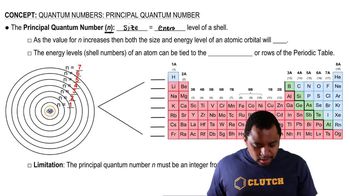
Principal Quantum Number
Aufbau Principle
The Aufbau principle states that electrons occupy the lowest energy orbitals first before filling higher energy levels. This principle guides the order in which orbitals are filled in an atom, which is crucial for determining the electron configuration. For hydrogen, the order of increasing energy for the given orbitals follows this principle, allowing us to rank them accurately.
추천 영상:
가이드 코스
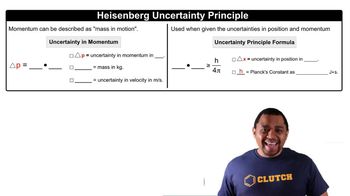
Uncertainty Principle Formula
Energy Levels and Sublevels
Energy levels in an atom are divided into sublevels (s, p, d, f) that have different energy states. The energy of these sublevels increases with the principal quantum number and the type of sublevel. For instance, within the same principal level, p orbitals are higher in energy than s orbitals, and d orbitals are higher than p orbitals. This hierarchy is essential for ordering the given orbitals by energy.
추천 영상:
가이드 코스
Nature of Energy
관련 실천
교과서 질문
859
views
교과서 질문
(a) For an He+ ion, do the 2s and 2p orbitals have the same energy? If not, which orbital has a lower energy?
862
views
교과서 질문
(b) If we add one electron to form the He atom, would your answer to part (a) change?
917
views
교과서 질문
(a) With reference to Figure 6.19, what is the relationship between the number of nodes in an s orbital and the value of the principal quantum number?
785
views
교과서 질문
(a) The average distance from the nucleus of a 3s electron in a chlorine atom is smaller than that for a 3p electron. In light of this fact, which orbital is higher in energy?
1123
views
교과서 질문
(b) Identify the number of nodes; that is, identify places where the electron density is zero, in the 2px orbital; in the 3s orbital.
748
views