Ch.6 - Electronic Structure of Atoms
Brown - Chemistry: The Central Science 14th Edition
Brown14th EditionChemistry: The Central ScienceISBN: 9780134414232당신이 사용하는 게 아니라요?교과서 변경
6장, 문제 45

Order the following transitions in the hydrogen atom from smallest to largest frequency of light absorbed: n = 3 to n = 7, n = 4 to n = 8, n = 2 to n = 5, and n = 1 to n = 3.

검증된 단계별 안내
1
Identify the initial and final energy levels for each transition. For example, for the transition n = 3 to n = 7, the initial level (ni) is 3 and the final level (nf) is 7.
Use the formula for the frequency of light absorbed during a transition in a hydrogen atom, which is derived from the energy difference between the two levels: \( \Delta E = E_f - E_i \) where \( E_n = -\frac{13.6 \text{ eV}}{n^2} \) for a hydrogen atom.
Calculate the energy difference for each transition using the formula: \( \Delta E = -13.6 \text{ eV} \left( \frac{1}{n_f^2} - \frac{1}{n_i^2} \right) \).
Convert the energy difference to frequency using the relation \( \Delta E = h \nu \), where \( h \) is Planck's constant. Solve for \( \nu \) to find the frequency: \( \nu = \frac{\Delta E}{h} \).
Compare the frequencies calculated for each transition to determine the order from smallest to largest frequency.

비슷한 문제에 대한 검증된 영상 답변:

이 영상 해법은 위 문제에 도움이 된다고 튜터들이 추천한 것입니다.

주요 개념

질문에 올바르게 답하기 위해 반드시 이해해야 하는 핵심 개념들은 다음과 같습니다.

Energy Levels in Hydrogen Atom

In a hydrogen atom, electrons occupy discrete energy levels, denoted by quantum numbers (n). The energy associated with each level increases with n, meaning that transitions between levels involve the absorption or emission of energy in the form of light. The difference in energy between two levels determines the frequency of the light absorbed or emitted during a transition.
추천 영상:
가이드 코스
01:22
Hydrogenation Reactions

Rydberg Formula

The Rydberg formula provides a way to calculate the wavelengths (and thus frequencies) of light emitted or absorbed during electron transitions in hydrogen. It states that the frequency of light (ν) is proportional to the difference in the inverse squares of the principal quantum numbers (n) of the initial and final states. This relationship allows for the determination of the frequency based on the specific transitions being analyzed.
추천 영상:
가이드 코스
02:26
Skeletal Formula

Frequency and Energy Relationship

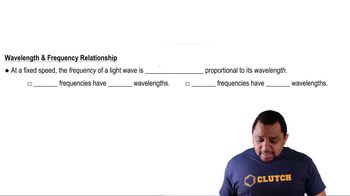
The frequency of light is directly related to its energy through the equation E = hν, where E is energy, h is Planck's constant, and ν is frequency. Higher energy transitions correspond to higher frequencies of light. Therefore, by calculating the energy differences for each transition, one can rank them from smallest to largest frequency absorbed.
추천 영상:
가이드 코스
00:31
Frequency-Wavelength Relationship