Ch.6 - Electronic Structure of Atoms
Brown - Chemistry: The Central Science 14th Edition
Brown14th EditionChemistry: The Central ScienceISBN: 9780134414232당신이 사용하는 게 아니라요?교과서 변경
6장, 문제 40b2

Consider a transition of the electron in the hydrogen atom from n = 8 to n = 3. (b) Will the light be absorbed or emitted?

검증된 단계별 안내
1
Identify the initial and final energy levels of the electron. In this case, the initial energy level (n_i) is 8 and the final energy level (n_f) is 3.
Understand that when an electron transitions between energy levels in an atom, energy is either absorbed or emitted. This depends on the direction of the electron's movement between energy levels.
Recognize that if the electron moves to a higher energy level (from a lower n to a higher n), energy is absorbed. Conversely, if the electron moves to a lower energy level (from a higher n to a lower n), energy is emitted.
Apply this understanding to the given transition from n = 8 to n = 3. Since the electron is moving from a higher energy level to a lower one, energy will be emitted in the form of light.
Conclude that for the transition of the electron from n = 8 to n = 3 in a hydrogen atom, light will be emitted.

비슷한 문제에 대한 검증된 영상 답변:

이 영상 해법은 위 문제에 도움이 된다고 튜터들이 추천한 것입니다.
영상 길이:
1m

주요 개념

질문에 올바르게 답하기 위해 반드시 이해해야 하는 핵심 개념들은 다음과 같습니다.

Energy Levels in Atoms

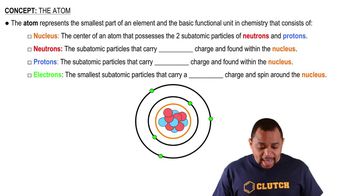
In an atom, electrons occupy specific energy levels, denoted by quantum numbers (n). The energy levels are quantized, meaning electrons can only exist at certain distances from the nucleus. The difference in energy between these levels determines whether energy is absorbed or emitted during electron transitions.
추천 영상:

Photon Emission and Absorption

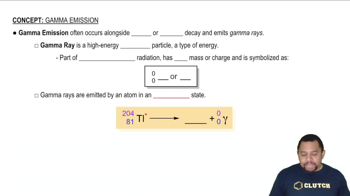
When an electron transitions from a higher energy level to a lower one, it emits a photon, releasing energy. Conversely, if an electron moves from a lower to a higher energy level, it absorbs a photon. The energy of the photon corresponds to the difference in energy between the two levels involved in the transition.
추천 영상:

Spectral Lines and Wavelength

The light emitted or absorbed during electron transitions results in spectral lines, which are unique to each element. The wavelength of the emitted or absorbed light can be calculated using the Rydberg formula, which relates the wavelengths to the energy levels of the electron transitions. This concept is crucial for understanding atomic spectra and identifying elements.
추천 영상:
가이드 코스
00:31
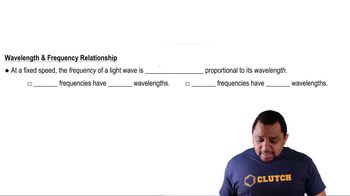
Frequency-Wavelength Relationship
관련 실천
교과서 질문

(b) Is this line in the visible region of the electromagnetic spectrum?

1
views

교과서 질문

(a) Using Equation 6.5, calculate the energy of an electron in the hydrogen atom when n = 3 and when n = 6. Calculate the wavelength of the radiation released when an electron moves from n = 6 to n = 3.

901
views
교과서 질문

The Lyman series of emission lines of the hydrogen atom are those for which nf = 1. (a) Determine the region of the electromagnetic spectrum in which the lines of the Lyman series are observed.

657
views
교과서 질문

The visible emission lines observed by Balmer all involved nf = 2. (b) Calculate the wavelengths of the first three lines in the Balmer series—those for which ni = 3, 4, and 5—and identify these lines in the emission spectrum shown in Figure 6.11.

1282
views
교과서 질문

The visible emission lines observed by Balmer all involved nf = 2. (a) Which of the following is the best explanation of why the lines with nf = 3 are not observed in the visible portion of the spectrum: (i) Transitions to nf = 3 are not allowed to happen, (ii) transitions to nf = 3 emit photons in the infrared portion of the spectrum, (iii) transitions to nf = 3 emit photons in the ultraviolet portion of the spectrum, or (iv) transitions to nf = 3 emit photons that are at exactly the same wavelengths as those to nf = 2.

1104
views
교과서 질문

Indicate whether energy is emitted or absorbed when the following electronic transitions occur in hydrogen: (a) from n = 2 to n = 3 (c) from the n = 9 to the n = 6 state.

752
views