Ch.6 - Electronic Structure of Atoms
Brown - Chemistry: The Central Science 14th Edition
Brown14th EditionChemistry: The Central ScienceISBN: 9780134414232당신이 사용하는 게 아니라요?교과서 변경
6장, 문제 100c

The Chemistry and Life box in Section 6.7 described the techniques called NMR and MRI. (c) When the 450-MHz photon is absorbed, does it change the spin of the electron or the proton on a hydrogen atom?

검증된 단계별 안내
1
Understand the context: NMR (Nuclear Magnetic Resonance) and MRI (Magnetic Resonance Imaging) are techniques that involve the interaction of magnetic fields with atomic nuclei, particularly focusing on hydrogen atoms.
Identify the key component: In NMR, the focus is on the nucleus of the hydrogen atom, which is a proton. The technique involves the absorption of radiofrequency photons by the nucleus.
Consider the frequency: The 450-MHz photon mentioned is a radiofrequency photon, which is typically used in NMR to interact with the nuclear spins, not electron spins.
Determine the effect: When a 450-MHz photon is absorbed in NMR, it causes a transition in the spin state of the proton (nucleus) in the hydrogen atom, not the electron.
Conclude the understanding: Therefore, the absorption of a 450-MHz photon in NMR changes the spin of the proton in the hydrogen atom.

비슷한 문제에 대한 검증된 영상 답변:

이 영상 해법은 위 문제에 도움이 된다고 튜터들이 추천한 것입니다.
영상 길이:
1m

주요 개념

질문에 올바르게 답하기 위해 반드시 이해해야 하는 핵심 개념들은 다음과 같습니다.

Nuclear Magnetic Resonance (NMR)

Nuclear Magnetic Resonance (NMR) is a spectroscopic technique that exploits the magnetic properties of certain atomic nuclei. When placed in a magnetic field, nuclei such as protons can absorb specific frequencies of electromagnetic radiation, leading to transitions between different energy states. This process is fundamental in determining the structure of organic compounds and is the basis for techniques like MRI in medical imaging.
추천 영상:
가이드 코스
01:42
Resonance Structures

Spin of Nuclei

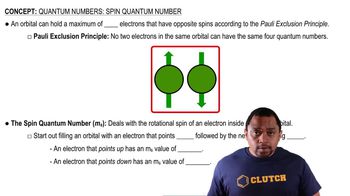
Spin is a fundamental property of particles, including protons and electrons, which can be thought of as a form of intrinsic angular momentum. In the context of NMR, the spin of the proton in a hydrogen atom is particularly important, as it determines how the nucleus interacts with magnetic fields. When a photon is absorbed, it can cause a change in the orientation of the spin state of the proton, but not the electron.
추천 영상:
가이드 코스
01:18
Spin Quantum Number

Photon Absorption

Photon absorption occurs when an atom or molecule takes in a photon, resulting in an increase in energy. In NMR, when a photon of a specific frequency (like 450 MHz) is absorbed by a hydrogen atom, it can promote the proton from a lower energy spin state to a higher energy state. This process does not affect the electron's spin, as the energy levels and transitions involved in NMR primarily pertain to the nuclear spins.
추천 영상:
가이드 코스
00:41
Moles and Photon Energy