Ch.6 - Electronic Structure of Atoms
Brown - Chemistry: The Central Science 14th Edition
Brown14th EditionChemistry: The Central ScienceISBN: 9780134414232당신이 사용하는 게 아니라요?교과서 변경
6장, 문제 100a

The Chemistry and Life box in Section 6.7 described the techniques called NMR and MRI. (a) Instruments for obtaining MRI data are typically labeled with a frequency, such as 600 MHz. In what region of the electromagnetic spectrum does a photon with this frequency belong?

검증된 단계별 안내
1
Identify the frequency given in the problem, which is 600 MHz. Convert this frequency into hertz (Hz) for standard calculations. Since 1 MHz = 10^6 Hz, multiply 600 by 10^6 to get the frequency in Hz.
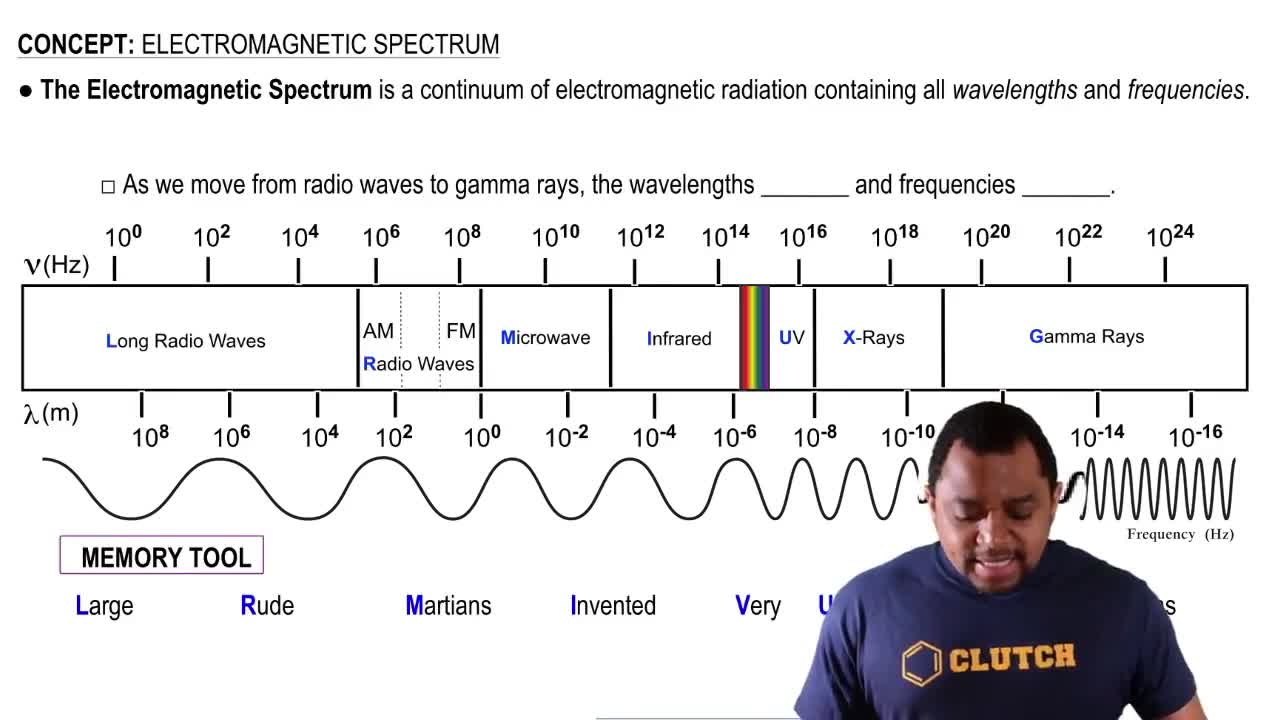
Recall the electromagnetic spectrum and the typical frequency ranges for different types of electromagnetic radiation. The main regions include radio waves, microwaves, infrared, visible light, ultraviolet, X-rays, and gamma rays.
Understand that NMR (Nuclear Magnetic Resonance) and MRI (Magnetic Resonance Imaging) typically use radio waves, which are at the lower frequency end of the electromagnetic spectrum.
Compare the converted frequency (in Hz) to the known frequency ranges of the electromagnetic spectrum. Radio waves generally have frequencies ranging from about 3 kHz to 300 GHz.
Conclude that a frequency of 600 MHz falls within the radio wave region of the electromagnetic spectrum, as it is well within the range of radio frequencies.

비슷한 문제에 대한 검증된 영상 답변:

이 영상 해법은 위 문제에 도움이 된다고 튜터들이 추천한 것입니다.
영상 길이:
2m

주요 개념

질문에 올바르게 답하기 위해 반드시 이해해야 하는 핵심 개념들은 다음과 같습니다.

Electromagnetic Spectrum

The electromagnetic spectrum encompasses all types of electromagnetic radiation, which vary in wavelength and frequency. It ranges from radio waves with long wavelengths to gamma rays with very short wavelengths. The spectrum is divided into regions, including radio, microwave, infrared, visible light, ultraviolet, X-rays, and gamma rays, each with distinct properties and applications.
추천 영상:
가이드 코스
02:53
Electromagnetic Spectrum

Frequency and Wavelength Relationship

Frequency and wavelength are inversely related properties of electromagnetic waves. The frequency (measured in hertz) indicates how many wave cycles pass a point per second, while wavelength (measured in meters) is the distance between successive peaks of the wave. This relationship is described by the equation c = λν, where c is the speed of light, λ is the wavelength, and ν is the frequency.
추천 영상:
가이드 코스
00:31
Frequency-Wavelength Relationship

Photon Energy

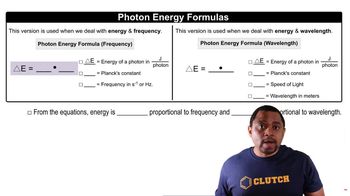
A photon is a quantum of electromagnetic radiation, and its energy is directly proportional to its frequency. The energy of a photon can be calculated using the equation E = hν, where E is energy, h is Planck's constant, and ν is frequency. Higher frequency photons, such as those in the MRI range, carry more energy compared to lower frequency photons, which are found in radio waves.
추천 영상:
가이드 코스
01:40
Photon Energy Formulas