
We will see in Chapter 12 that semiconductors are materials that conduct electricity better than nonmetals but not as well as metals. The only two elements in the periodic table that are technologically useful semiconductors are silicon and germanium. Integrated circuits in computer chips today are based on silicon. Compound semiconductors are also used in the electronics industry. Examples are gallium arsenide, GaAs; gallium phosphide, GaP; cadmium sulfide, CdS; and cadmium selenide, CdSe. (b) Workers in the semiconductor industry refer to 'II–VI' and 'III–V' materials, using Roman numerals. Can you identify which compound semiconductors are II–VI and which are III–V? (c) Suggest other compositions of compound semiconductors based on the positions of their elements in the periodic table.
Ch.7 - Periodic Properties of the Elements

Brown14th EditionChemistry: The Central ScienceISBN: 9780134414232
당신이 사용하는 게 아니라요?교과서 변경다른 교과서를 선택하세요
TOC.tableOfContents
- Ch.1 - Introduction: Matter, Energy, and Measurement177
- Ch.2 - Atoms, Molecules, and Ions231
- Ch.3 - Chemical Reactions and Reaction Stoichiometry216
- Ch.4 - Reactions in Aqueous Solution189
- Ch.5 - Thermochemistry175
- Ch.6 - Electronic Structure of Atoms168
- Ch.7 - Periodic Properties of the Elements150
- Ch.8 - Basic Concepts of Chemical Bonding177
- Ch.9 - Molecular Geometry and Bonding Theories200
- Ch.10 - Gases179
- Ch.11 - Liquids and Intermolecular Forces113
- Ch.12 - Solids and Modern Materials154
- Ch.13 - Properties of Solutions157
- Ch.14 - Chemical Kinetics199
- Ch.15 - Chemical Equilibrium128
- Ch.16 - Acid-Base Equilibria164
- Ch.17 - Additional Aspects of Aqueous Equilibria163
- Ch.18 - Chemistry of the Environment105
- Ch.19 - Chemical Thermodynamics164
- Ch.20 - Electrochemistry171
- Ch.21 - Nuclear Chemistry122
- Ch.22 - Chemistry of the Nonmetals82
- Ch.23 - Transition Metals and Coordination Chemistry79
- Ch.24 - The Chemistry of Life: Organic and Biological Chemistry16
7장, 문제 106
A historian discovers a nineteenth-century notebook in which some observations, dated 1822, were recorded on a substance thought to be a new element. Here are some of the data recorded in the notebook: 'Ductile, silver-white, metallic looking. Softer than lead. Unaffected by water. Stable in air. Melting point: 153 °C. Density: 7.3 g>cm3. Electrical conductivity: 20% that of copper. Hardness: About 1% as hard as iron. When 4.20 g of the unknown is heated in an excess of oxygen, 5.08 g of a white solid is formed. The solid could be sublimed by heating to over 800 °C.' (a) Using information in the text and the CRC Handbook of Chemistry and Physics, and making allowances for possible variations in numbers from current values, identify the element reported.
 검증된 단계별 안내
1
Identify the physical properties of the unknown element: ductile, silver-white, metallic, softer than lead, unaffected by water, stable in air, melting point of 153 °C, density of 7.3 g/cm³, electrical conductivity 20% of copper, hardness 1% of iron.
Compare these properties with known elements from the CRC Handbook of Chemistry and Physics, focusing on elements with similar melting points, densities, and conductivity.
Consider the chemical reaction: 4.20 g of the unknown element reacts with oxygen to form 5.08 g of a white solid. Calculate the mass of oxygen that reacted by subtracting the mass of the unknown from the mass of the product.
Determine the molar mass of the unknown element by using the mass of the unknown and the mass of oxygen to find the empirical formula of the oxide formed.
Cross-reference the calculated molar mass and empirical formula with known elements to identify the element that matches the properties and reaction data.
비슷한 문제에 대한 검증된 영상 답변:
이 영상 해법은 위 문제에 도움이 된다고 튜터들이 추천한 것입니다.

영상 길이:
2m주요 개념
질문에 올바르게 답하기 위해 반드시 이해해야 하는 핵심 개념들은 다음과 같습니다.
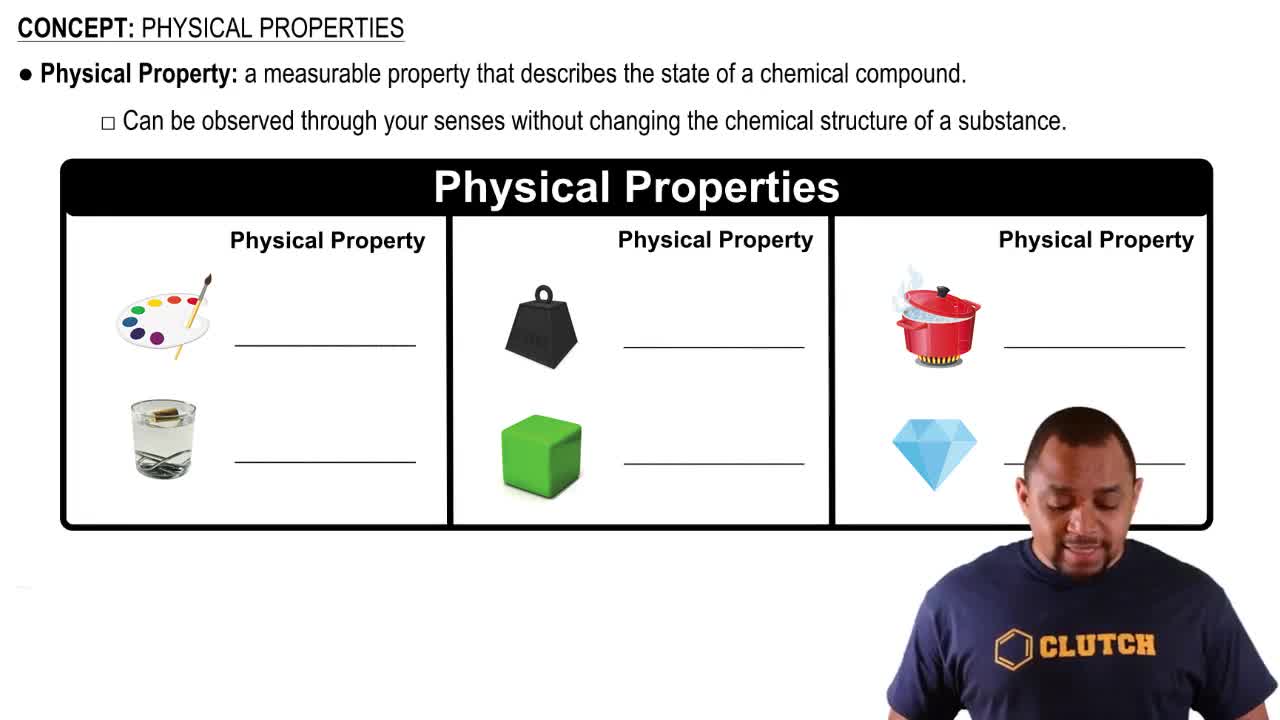
Physical Properties of Metals
The observations recorded in the notebook describe several physical properties of the unknown element, such as ductility, density, and melting point. Metals typically exhibit high electrical conductivity, malleability, and a shiny appearance. Understanding these properties helps in identifying the element, as they can be compared to known metals to narrow down possibilities.
추천 영상:
가이드 코스
 02:54
02:54
Physical Properties
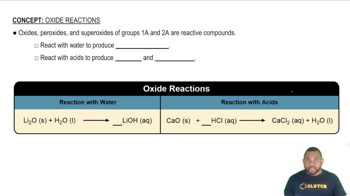
Chemical Reactivity and Oxidation
The reaction of the unknown element with oxygen, resulting in a white solid, indicates its chemical reactivity. The formation of a solid product upon heating in excess oxygen suggests that the element may form an oxide. Analyzing the mass change during the reaction can provide insights into the element's identity and its oxidation state.
추천 영상:
가이드 코스
 00:58
00:58Oxide Reactions
Density and Element Identification
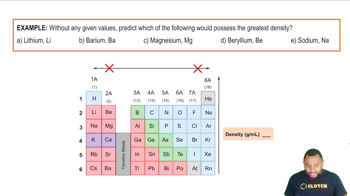
Density is a critical physical property used to identify elements. The recorded density of 7.3 g/cm³ can be compared to known densities of metals to help pinpoint the unknown element. Since density is a characteristic property, it can significantly narrow down the list of potential candidates when combined with other observed properties.
추천 영상:
가이드 코스
 00:50
00:50Main Group Elements: Density Example
관련 실천
교과서 질문
297
views
교과서 질문
We will see in Chapter 12 that semiconductors are materials that conduct electricity better than nonmetals but not as well as metals. The only two elements in the periodic table that are technologically useful semiconductors are silicon and germanium. Integrated circuits in computer chips today are based on silicon. Compound semiconductors are also used in the electronics industry. Examples are gallium arsenide, GaAs; gallium phosphide, GaP; cadmium sulfide, CdS; and cadmium selenide, CdSe. (a) What is the relationship between the compound semiconductors' compositions and the positions of their elements on the periodic table relative to Si and Ge?
286
views