
A historian discovers a nineteenth-century notebook in which some observations, dated 1822, were recorded on a substance thought to be a new element. Here are some of the data recorded in the notebook: 'Ductile, silver-white, metallic looking. Softer than lead. Unaffected by water. Stable in air. Melting point: 153 °C. Density: 7.3 g>cm3. Electrical conductivity: 20% that of copper. Hardness: About 1% as hard as iron. When 4.20 g of the unknown is heated in an excess of oxygen, 5.08 g of a white solid is formed. The solid could be sublimed by heating to over 800 °C.' (a) Using information in the text and the CRC Handbook of Chemistry and Physics, and making allowances for possible variations in numbers from current values, identify the element reported.

- Ch.1 - Introduction: Matter, Energy, and Measurement177
- Ch.2 - Atoms, Molecules, and Ions231
- Ch.3 - Chemical Reactions and Reaction Stoichiometry216
- Ch.4 - Reactions in Aqueous Solution189
- Ch.5 - Thermochemistry175
- Ch.6 - Electronic Structure of Atoms168
- Ch.7 - Periodic Properties of the Elements150
- Ch.8 - Basic Concepts of Chemical Bonding177
- Ch.9 - Molecular Geometry and Bonding Theories200
- Ch.10 - Gases179
- Ch.11 - Liquids and Intermolecular Forces113
- Ch.12 - Solids and Modern Materials154
- Ch.13 - Properties of Solutions157
- Ch.14 - Chemical Kinetics199
- Ch.15 - Chemical Equilibrium128
- Ch.16 - Acid-Base Equilibria164
- Ch.17 - Additional Aspects of Aqueous Equilibria163
- Ch.18 - Chemistry of the Environment105
- Ch.19 - Chemical Thermodynamics164
- Ch.20 - Electrochemistry171
- Ch.21 - Nuclear Chemistry122
- Ch.22 - Chemistry of the Nonmetals82
- Ch.23 - Transition Metals and Coordination Chemistry79
- Ch.24 - The Chemistry of Life: Organic and Biological Chemistry16
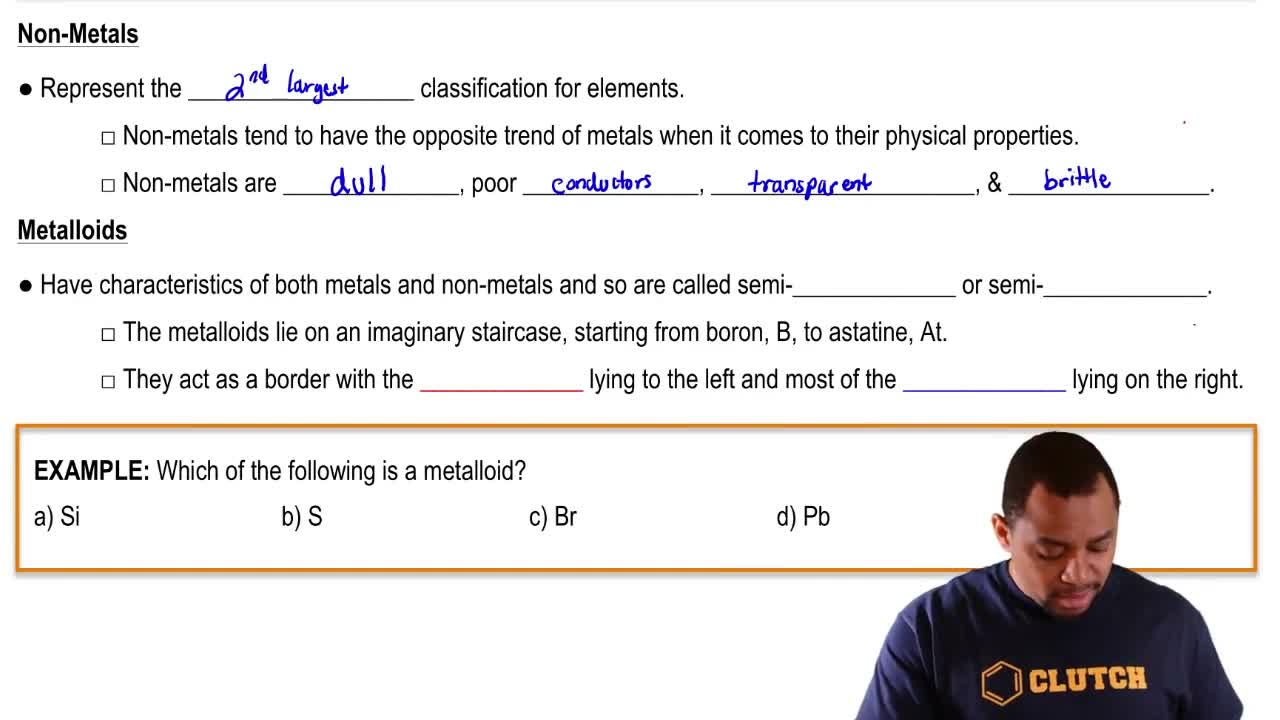
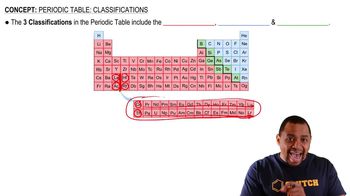
We will see in Chapter 12 that semiconductors are materials that conduct electricity better than nonmetals but not as well as metals. The only two elements in the periodic table that are technologically useful semiconductors are silicon and germanium. Integrated circuits in computer chips today are based on silicon. Compound semiconductors are also used in the electronics industry. Examples are gallium arsenide, GaAs; gallium phosphide, GaP; cadmium sulfide, CdS; and cadmium selenide, CdSe. (a) What is the relationship between the compound semiconductors' compositions and the positions of their elements on the periodic table relative to Si and Ge?
 검증된 단계별 안내
비슷한 문제에 대한 검증된 영상 답변:

주요 개념
Semiconductors
 03:37
03:37
Periodic Table Positioning
 02:40
02:40Compound Semiconductors
 02:11
02:11We will see in Chapter 12 that semiconductors are materials that conduct electricity better than nonmetals but not as well as metals. The only two elements in the periodic table that are technologically useful semiconductors are silicon and germanium. Integrated circuits in computer chips today are based on silicon. Compound semiconductors are also used in the electronics industry. Examples are gallium arsenide, GaAs; gallium phosphide, GaP; cadmium sulfide, CdS; and cadmium selenide, CdSe. (b) Workers in the semiconductor industry refer to 'II–VI' and 'III–V' materials, using Roman numerals. Can you identify which compound semiconductors are II–VI and which are III–V? (c) Suggest other compositions of compound semiconductors based on the positions of their elements in the periodic table.
Moseley established the concept of atomic number by studying X rays emitted by the elements. The X rays emitted by some of the elements have the following wavelengths: Element Wavelength (pm) Ne 1461 Ca 335.8 Zn 143.5 Zr 78.6 Sn 49.1 (b) Plot the square root of n versus the atomic number of the element. What do you observe about the plot? (e) A particular element emits X rays with a wavelength of 98.0 pm. What element do you think it is?
Moseley established the concept of atomic number by studying X rays emitted by the elements. The X rays emitted by some of the elements have the following wavelengths: Element Wavelength (pm) Ne 1461 Ca 335.8 Zn 143.5 Zr 78.6 Sn 49.1 (a) Calculate the frequency, n, of the X rays emitted by each of the elements, in Hz.