
Ch.7 - Periodic Properties of the Elements
Brown - Chemistry: The Central Science 14th Edition
Brown14th EditionChemistry: The Central ScienceISBN: 9780134414232당신이 사용하는 게 아니라요?교과서 변경
7장, 문제 89

(a) Which ion is smaller, Co3+ or Co4+? (b) In a lithium-ion battery that is discharging to power a device, for every Li+ that inserts into the lithium cobalt oxide electrode, a Co4+ ion must be reduced to a Co3+ ion to balance charge. Using the CRC Handbook of Chemistry and Physics or other standard reference, find the ionic radii of Li+, Co3+, and Co4+. Order these ions from smallest to largest.

검증된 단계별 안내
1
To determine which ion is smaller between Co3+ and Co4+, consider the concept of effective nuclear charge. As the positive charge on the ion increases, the effective nuclear charge experienced by the electrons also increases, pulling them closer to the nucleus and resulting in a smaller ionic radius. Therefore, Co4+ is expected to be smaller than Co3+.
In a lithium-ion battery, when a Li+ ion inserts into the lithium cobalt oxide electrode, a Co4+ ion is reduced to Co3+. This process maintains charge balance within the electrode.
To find the ionic radii of Li+, Co3+, and Co4+, consult a reliable reference such as the CRC Handbook of Chemistry and Physics. Look up the specific ionic radii values for each ion.
Once you have the ionic radii values, compare them to order the ions from smallest to largest. Remember that the ionic radius is influenced by the charge and the number of electrons in the ion.
Based on the typical trends and the data from the reference, you should be able to order the ions. Generally, Co4+ will be the smallest due to its higher positive charge, followed by Co3+, and then Li+ as the largest due to its lower charge and larger ionic radius.

주요 개념

질문에 올바르게 답하기 위해 반드시 이해해야 하는 핵심 개념들은 다음과 같습니다.

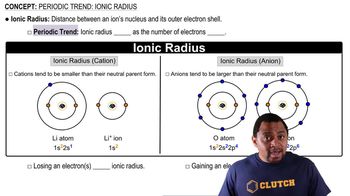
Ionic Radius

The ionic radius is a measure of the size of an ion in a crystal lattice. It is influenced by the ion's charge and the number of electrons relative to protons. Cations, which are positively charged ions, are generally smaller than their neutral atoms due to the loss of electrons and increased effective nuclear charge, which pulls the remaining electrons closer to the nucleus.
추천 영상:

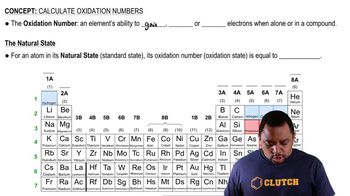
Oxidation States

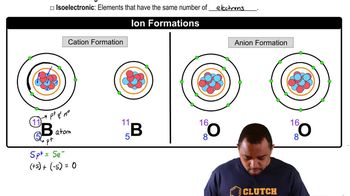
Oxidation states indicate the degree of oxidation of an atom in a compound, reflecting the number of electrons lost or gained. In the case of cobalt, Co3+ has lost three electrons, while Co4+ has lost four. The higher the oxidation state, the greater the positive charge, which typically results in a smaller ionic radius due to increased attraction between the nucleus and the remaining electrons.
추천 영상:
가이드 코스
02:42
Oxidation Numbers

Lithium-Ion Battery Chemistry

In lithium-ion batteries, lithium ions (Li+) move between the anode and cathode during charging and discharging. The reduction of Co4+ to Co3+ in the cathode during discharge is crucial for maintaining charge balance. Understanding this process is essential for analyzing the performance and efficiency of lithium-ion batteries, as it directly relates to the movement of ions and the associated changes in oxidation states.
추천 영상: