


Ch.7 - Periodic Properties of the Elements
Brown - Chemistry: The Central Science 14th Edition
Brown14th EditionChemistry: The Central ScienceISBN: 9780134414232당신이 사용하는 게 아니라요?교과서 변경
7장, 문제 88

Note from the following table that there is a significant increase in atomic radius upon moving from Y to La, whereas the radii of Zr to Hf are the same. Suggest an explanation for this effect. Atomic Radii (pm) Sc 170 Ti 160 Y 190 Zr 175 La 207 Hf 175

검증된 단계별 안내
1
Identify the position of the elements (Sc, Ti, Y, Zr, La, Hf) in the periodic table. Note that Sc, Y, and La are in Group 3, while Ti, Zr, and Hf are in Group 4. This positioning helps in understanding their electronic configuration and trends.
Understand the concept of atomic radius and how it generally increases down a group due to the addition of electron shells. This explains the increase in atomic radius from Sc to Y to La.
Consider the concept of lanthanide contraction, which is the phenomenon where the atomic and ionic radii of the lanthanides decrease from one element to the next. This is due to the poor shielding effect of the 4f electrons.
Apply the concept of lanthanide contraction to understand why the atomic radius of La is significantly larger than Y. Despite being in the same group, the addition of 4f electrons in lanthanides (which starts from La) leads to poor shielding and thus smaller increases in atomic radii than expected without the 4f electrons.
Examine the transition from Zr to Hf in Group 4, noting that both elements have nearly the same atomic radius. This can be attributed to the effective shielding by the 4f electrons in Hf, which compensates for the increase in nuclear charge, thus maintaining a similar size as Zr.

비슷한 문제에 대한 검증된 영상 답변:

이 영상 해법은 위 문제에 도움이 된다고 튜터들이 추천한 것입니다.
영상 길이:
13m
도움이 되었나요?

주요 개념

질문에 올바르게 답하기 위해 반드시 이해해야 하는 핵심 개념들은 다음과 같습니다.

Atomic Radius

Atomic radius refers to the distance from the nucleus of an atom to the outermost shell of electrons. It generally increases down a group in the periodic table due to the addition of electron shells, which outweighs the increase in nuclear charge. However, trends can vary across periods and groups due to factors like electron shielding and effective nuclear charge.
추천 영상:

Lanthanide Contraction

Lanthanide contraction is the phenomenon where the atomic and ionic radii of the lanthanide series elements decrease with increasing atomic number. This occurs due to the poor shielding effect of the f-electrons, which leads to a greater effective nuclear charge felt by the outer electrons, resulting in a smaller atomic radius as one moves from La to Lu.
추천 영상:
가이드 코스
02:30
Lanthanide Contraction

Transition Metals and d-Orbital Electrons

Transition metals, such as Zr and Hf, have d-orbital electrons that contribute to their chemical properties and atomic size. The presence of these d-electrons can lead to a more stable electron configuration, which can result in similar atomic radii across certain transition metals, despite an increase in atomic number, due to effective shielding and electron-electron repulsion balancing out.
추천 영상:
가이드 코스
02:06
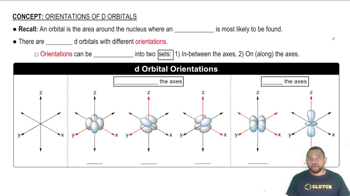
d Orbital Orientations