
Which of the following statements about effective nuclear charge for the outermost valence electron of an atom is incorrect? (i) The effective nuclear charge can be thought of as the true nuclear charge minus a screening constant due to the other electrons in the atom. (ii) Effective nuclear charge increases going left to right across a row of the periodic table. (iii) Valence electrons screen the nuclear charge more effectively than do core electrons. (iv) The effective nuclear charge shows a sudden decrease when we go from the end of one row to the beginning of the next row of the periodic table. (v) The change in effective nuclear charge going down a column of the periodic table is generally less than that going across a row of the periodic table

- Ch.1 - Introduction: Matter, Energy, and Measurement177
- Ch.2 - Atoms, Molecules, and Ions231
- Ch.3 - Chemical Reactions and Reaction Stoichiometry216
- Ch.4 - Reactions in Aqueous Solution189
- Ch.5 - Thermochemistry175
- Ch.6 - Electronic Structure of Atoms168
- Ch.7 - Periodic Properties of the Elements150
- Ch.8 - Basic Concepts of Chemical Bonding177
- Ch.9 - Molecular Geometry and Bonding Theories200
- Ch.10 - Gases179
- Ch.11 - Liquids and Intermolecular Forces113
- Ch.12 - Solids and Modern Materials154
- Ch.13 - Properties of Solutions157
- Ch.14 - Chemical Kinetics199
- Ch.15 - Chemical Equilibrium128
- Ch.16 - Acid-Base Equilibria164
- Ch.17 - Additional Aspects of Aqueous Equilibria163
- Ch.18 - Chemistry of the Environment105
- Ch.19 - Chemical Thermodynamics164
- Ch.20 - Electrochemistry171
- Ch.21 - Nuclear Chemistry122
- Ch.22 - Chemistry of the Nonmetals82
- Ch.23 - Transition Metals and Coordination Chemistry79
- Ch.24 - The Chemistry of Life: Organic and Biological Chemistry16
Among the elements N, O, P, and S, which element or elements have the smallest effect nuclear charge if we use Equation 7.1 to calculate Zeff? Which element or elements have the largest effective nuclear charge?
 검증된 단계별 안내
비슷한 문제에 대한 검증된 영상 답변:

주요 개념
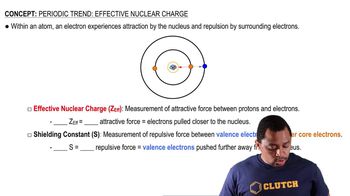
Effective Nuclear Charge (Zeff)
 01:51
01:51
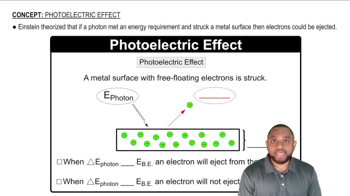
Shielding Effect
 02:31
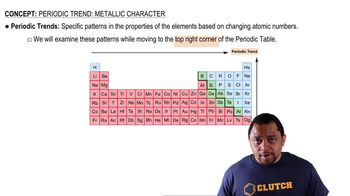
02:31Trends in the Periodic Table
 00:38
00:38The prefix eka- comes from the Sanskrit word for 'one.' Mendeleev used this prefix to indicate that the unknown element was one place away from the known element that followed the prefix. For example, eka-silicon, which we now call germanium, is one element below silicon. Mendeleev also predicted the existence of eka-manganese, which was not experimentally confirmed until 1937 because this element is radioactive and does not occur in nature. Based on the periodic table shown in Figure 7.1, what do we now call the element Mendeleev called eka-manganese?
Detailed calculations show that the value of Zeff for the outermost electrons in Na and K atoms is 2.51+ and 3.49+, respectively. (b) What values do you estimate for Zeff using Slater’s rules?
Detailed calculations show that the value of Zeff for the outermost electrons in Na and K atoms is 2.51+ and 3.49+, respectively. (a) What value do you estimate for Zeff experienced by the outermost electron in both Na and K by assuming core electrons contribute 1.00 and valence electrons contribute 0.00 to the screening constant?