Ch.7 - Periodic Properties of the Elements
Brown - Chemistry: The Central Science 14th Edition
Brown14th EditionChemistry: The Central ScienceISBN: 9780134414232당신이 사용하는 게 아니라요?교과서 변경
7장, 문제 64b

An element X reacts with oxygen to form XO2 and with chlorine to form XCl4. XO2 is a white solid that melts at high temperatures (above 1000 °C). Under usual conditions, XCl4 is a colorless liquid with a boiling point of 58 °C. (b) Do you think that element X is a metal, nonmetal, or metalloid?

검증된 단계별 안내
1
Identify the properties of the compounds formed by element X: XO2 is a white solid with a high melting point, and XCl4 is a colorless liquid with a low boiling point.
Analyze the oxidation states and types of compounds formed: XO2 suggests that X forms a dioxide, typical for nonmetals forming covalent bonds with oxygen. XCl4 indicates that X can achieve a +4 oxidation state, common in covalent compounds with nonmetals.
Consider the physical properties of the compounds: The high melting point of XO2 suggests strong covalent bonding typical in nonmetal oxides. The low boiling point of XCl4 suggests volatile nature typical of molecular compounds formed by nonmetals.
Compare with known elements: Elements that form dioxides and tetrachlorides with similar properties are generally nonmetals, such as sulfur forming SO2 and SiCl4.
Conclude the type of element X based on the evidence: Given the covalent nature of the compounds and their physical properties, element X is likely a nonmetal.

비슷한 문제에 대한 검증된 영상 답변:

이 영상 해법은 위 문제에 도움이 된다고 튜터들이 추천한 것입니다.
영상 길이:
1m

주요 개념

질문에 올바르게 답하기 위해 반드시 이해해야 하는 핵심 개념들은 다음과 같습니다.

Oxidation States and Reactivity

The oxidation state of an element indicates its degree of oxidation or reduction in a compound. In this case, element X forms XO2, suggesting it has a +4 oxidation state when reacting with oxygen, which is typical for nonmetals. Understanding oxidation states helps in predicting the behavior of elements in reactions, particularly in determining whether they are metals, nonmetals, or metalloids.
추천 영상:
가이드 코스
00:58
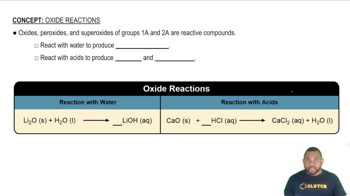
Oxide Reactions

Properties of Compounds

The physical properties of the compounds formed by element X provide insight into its classification. XO2 is a high-melting white solid, characteristic of many nonmetal oxides, while XCl4 is a colorless liquid with a low boiling point, indicating a covalent nature. Analyzing these properties helps in deducing the elemental nature of X based on the behavior of its compounds.
추천 영상:
가이드 코스
03:31
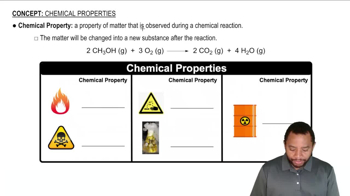
Chemical Properties

Metallic vs. Nonmetallic Characteristics

Metals typically exhibit high melting and boiling points, good conductivity, and form ionic compounds, while nonmetals have lower melting points, can form covalent compounds, and are often insulators. The contrasting properties of XO2 and XCl4 suggest that element X is likely a nonmetal, as it forms a solid oxide with high melting point and a low-boiling liquid chloride.
추천 영상:
가이드 코스
02:59
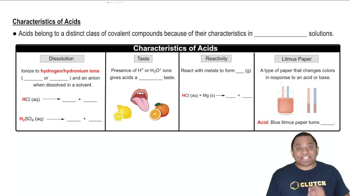
Acid Characteristics
관련 실천
교과서 질문

Chlorine reacts with oxygen to form Cl2O7. (c) Would you expect Cl2O7 to be more reactive toward H+1aq2 or OH-1aq2?

543
views
1
rank

교과서 질문

An element X reacts with oxygen to form XO2 and with chlorine to form XCl4. XO2 is a white solid that melts at high temperatures (above 1000 °C). Under usual conditions, XCl4 is a colorless liquid with a boiling point of 58 °C. (a) XCl4 reacts with water to form XO2 and another product. What is the likely identity of the other product?

718
views
교과서 질문

An element X reacts with oxygen to form XO2 and with chlorine to form XCl4. XO2 is a white solid that melts at high temperatures (above 1000 °C). Under usual conditions, XCl4 is a colorless liquid with a boiling point of 58 °C. (c) By using a sourcebook such as the CRC Handbook of Chemistry and Physics, try to determine the identity of element X.

2
views
교과서 질문

Write balanced equations for the following reactions: (a) sulfur dioxide with water (b) lithium oxide in water (c) zinc oxide with dilute hydrochloric acid (d) arsenic trioxide with aqueous potassium hydroxide.

348
views
교과서 질문

Write balanced equations for the following reactions: (a) boron trichloride with water (b) cobalt (II) oxide with nitric acid (d) carbon dioxide with aqueous barium hydroxide.

357
views
교과서 질문

Chlorine reacts with oxygen to form Cl2O7 . (d) If the oxygen in Cl2O7 is considered to have the -2 oxidation state, what is the oxidation state of the Cl? What is the electron configuration of Cl in this oxidation state?