Ch.7 - Periodic Properties of the Elements
Brown - Chemistry: The Central Science 14th Edition
Brown14th EditionChemistry: The Central ScienceISBN: 9780134414232당신이 사용하는 게 아니라요?교과서 변경
7장, 문제 28

Explain the following variations in atomic or ionic radii: (a) I- > I > I+ (b) Ca2+ > Mg2+ > Be2+ (c) Fe > Fe2+ > Fe3+

검증된 단계별 안내
1
Step 1: Understand the concept of atomic and ionic radii. Atomic radius is the distance from the nucleus to the outermost electron shell of an atom. Ionic radius is similar but refers to the size of an ion, which can be larger or smaller than the atomic radius depending on whether the ion is an anion (gains electrons) or a cation (loses electrons).
Step 2: Analyze the trend in (a) I- > I > I+. Iodine (I) is a neutral atom, I- is an anion with an extra electron, and I+ is a cation with one less electron. Adding an electron to form I- increases electron-electron repulsion, expanding the electron cloud and increasing the radius. Removing an electron to form I+ reduces repulsion and the electron cloud contracts, decreasing the radius.
Step 3: Examine the trend in (b) Ca2+ > Mg2+ > Be2+. These are all cations of elements in the same group (alkaline earth metals) but different periods. As you move up the group from Ca to Be, the number of electron shells decreases, leading to a smaller ionic radius. Additionally, the effective nuclear charge increases, pulling the remaining electrons closer to the nucleus.
Step 4: Consider the trend in (c) Fe > Fe2+ > Fe3+. Iron (Fe) is a neutral atom, Fe2+ is a cation with two electrons removed, and Fe3+ has three electrons removed. Each removal of an electron reduces electron-electron repulsion and increases the effective nuclear charge per electron, causing the electron cloud to contract and the ionic radius to decrease.
Step 5: Summarize the general principle: For anions, gaining electrons increases the ionic radius due to increased repulsion, while for cations, losing electrons decreases the ionic radius due to reduced repulsion and increased effective nuclear charge. Additionally, within a group, ionic radii decrease with fewer electron shells and increased nuclear charge.

주요 개념

질문에 올바르게 답하기 위해 반드시 이해해야 하는 핵심 개념들은 다음과 같습니다.

Atomic and Ionic Radii

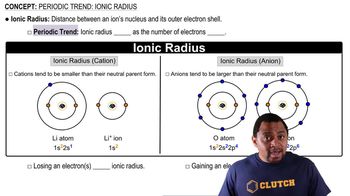
Atomic radius refers to the size of an atom, typically measured from the nucleus to the outermost electron shell. Ionic radius is the size of an ion, which can differ from the atomic radius due to the loss or gain of electrons. Cations (positively charged ions) are generally smaller than their neutral atoms because the loss of electrons reduces electron-electron repulsion, while anions (negatively charged ions) are larger due to increased repulsion from added electrons.
추천 영상:
가이드 코스
03:56
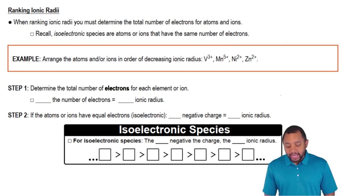
Ranking Ionic Radii

Trends in Ionic Size

Ionic size trends can be understood through the concepts of effective nuclear charge and electron shielding. As you move across a period, the effective nuclear charge increases, pulling electrons closer and reducing ionic size. Conversely, as you move down a group, additional electron shells increase shielding, leading to larger ionic radii despite the increase in nuclear charge.
추천 영상:

Oxidation States and Their Effects

The oxidation state of an element affects its ionic radius due to changes in electron configuration. For transition metals like iron, the loss of electrons when forming cations leads to a decrease in size. For example, Fe3+ is smaller than Fe2+ because the removal of additional electrons increases the effective nuclear charge on the remaining electrons, pulling them closer to the nucleus.
추천 영상:
가이드 코스
02:31
Photoelectric Effect