Ch.7 - Periodic Properties of the Elements
Brown - Chemistry: The Central Science 14th Edition
Brown14th EditionChemistry: The Central ScienceISBN: 9780134414232당신이 사용하는 게 아니라요?교과서 변경
7장, 문제 29

Use data from Appendix C, Figure 7.10, and Figure 7.12 to calculate the lattice energy of RbCl.

검증된 단계별 안내
1
Identify the Born-Haber cycle for RbCl, which involves the following steps: sublimation of Rb, ionization of Rb, dissociation of Cl2, electron affinity of Cl, and formation of RbCl from gaseous ions.
Write the equation for the formation of RbCl from its elements in their standard states: \( \text{Rb(s)} + \frac{1}{2} \text{Cl}_2(g) \rightarrow \text{RbCl(s)} \).
Use the enthalpy of sublimation for Rb to convert solid Rb to gaseous Rb: \( \text{Rb(s)} \rightarrow \text{Rb(g)} \).
Use the ionization energy of Rb to convert gaseous Rb to \( \text{Rb}^+ \): \( \text{Rb(g)} \rightarrow \text{Rb}^+(g) + e^- \).
Use the electron affinity of Cl to convert gaseous Cl to \( \text{Cl}^- \): \( \text{Cl}(g) + e^- \rightarrow \text{Cl}^-(g) \).

비슷한 문제에 대한 검증된 영상 답변:

이 영상 해법은 위 문제에 도움이 된다고 튜터들이 추천한 것입니다.
영상 길이:
3m

주요 개념

질문에 올바르게 답하기 위해 반드시 이해해야 하는 핵심 개념들은 다음과 같습니다.

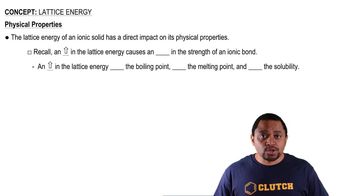
Lattice Energy

Lattice energy is the amount of energy released when gaseous ions combine to form an ionic solid. It is a measure of the strength of the forces between the ions in an ionic compound. Higher lattice energy indicates stronger ionic bonds, which typically results in higher melting and boiling points for the compound.
추천 영상:

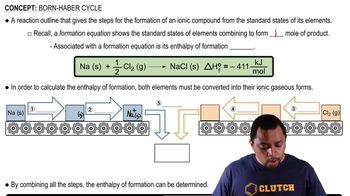
Born-Haber Cycle

The Born-Haber cycle is a thermodynamic cycle that relates the lattice energy of an ionic compound to other energy changes involved in its formation. It includes steps such as ionization energy, electron affinity, and sublimation energy, allowing for the calculation of lattice energy using Hess's law. This cycle is essential for understanding how lattice energy can be derived from other measurable quantities.
추천 영상:
가이드 코스
03:49
Born Haber Cycle

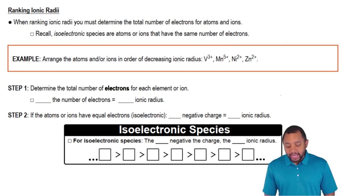
Ionic Radii

Ionic radii refer to the effective size of an ion in a crystal lattice. The size of the ions affects the distance between them, which in turn influences the lattice energy. Smaller ions can pack more closely together, leading to stronger electrostatic attractions and higher lattice energies, while larger ions result in weaker attractions and lower lattice energies.
추천 영상:
가이드 코스
03:56
Ranking Ionic Radii