

Ch.7 - Periodic Properties of the Elements
Brown - Chemistry: The Central Science 14th Edition
Brown14th EditionChemistry: The Central ScienceISBN: 9780134414232당신이 사용하는 게 아니라요?교과서 변경
7장, 문제 91

Explain the variation in the ionization energies of carbon, as displayed in this graph:

검증된 단계별 안내
1
Ionization energy is the energy required to remove an electron from an atom in the gaseous state.
For carbon, the first ionization energy involves removing one electron from a neutral carbon atom.
The second ionization energy involves removing a second electron from the positively charged ion, which requires more energy due to increased effective nuclear charge.
As more electrons are removed, the ionization energy increases because the remaining electrons are held more tightly by the nucleus.
The graph likely shows a significant increase in ionization energy after the removal of the fourth electron, as this involves breaking into a new electron shell, which is more stable and requires more energy to remove an electron from.

비슷한 문제에 대한 검증된 영상 답변:

이 영상 해법은 위 문제에 도움이 된다고 튜터들이 추천한 것입니다.
영상 길이:
1m

주요 개념

질문에 올바르게 답하기 위해 반드시 이해해야 하는 핵심 개념들은 다음과 같습니다.

Ionization Energy

Ionization energy is the energy required to remove an electron from an atom or ion in its gaseous state. It reflects the strength of the attraction between the nucleus and the electrons. Higher ionization energy indicates a stronger hold on the electrons, while lower ionization energy suggests that electrons can be removed more easily.
추천 영상:
가이드 코스
01:19
Ionization Energy

Trends in Ionization Energy

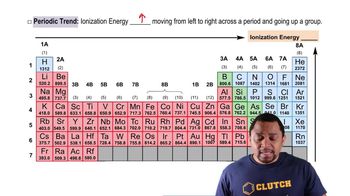
Ionization energy generally increases across a period in the periodic table due to increasing nuclear charge, which enhances the attraction between the nucleus and the electrons. Conversely, it decreases down a group because the added electron shells increase the distance between the nucleus and the outermost electrons, reducing the effective nuclear charge experienced by these electrons.
추천 영상:
가이드 코스
01:08
Ionization Energy Trends

Electron Configuration

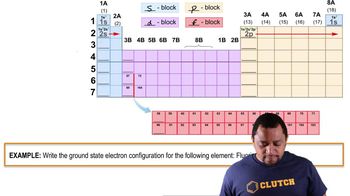
The electron configuration of an element describes the distribution of electrons among the various atomic orbitals. For carbon, with an atomic number of 6, the electron configuration is 1s² 2s² 2p². Understanding this configuration helps explain the ionization energies, as the arrangement of electrons influences how easily they can be removed from the atom.
추천 영상:
가이드 코스
01:33
Electron Configuration Example
관련 실천
교과서 질문

The ionic substance strontium oxide, SrO, forms from the reaction of strontium metal with molecular oxygen. The arrangement of the ions in solid SrO is analogous to that in solid NaCl:

(c) The density of SrO is 5.10 g>cm3. Given your answer to part (b), how many formula units of SrO are contained in the cube shown here?

1144
views
교과서 질문

The ionic substance strontium oxide, SrO, forms from the reaction of strontium metal with molecular oxygen. The arrangement of the ions in solid SrO is analogous to that in solid NaCl: (a) Write a balanced equation for the formation of SrO(s) from its elements.

1034
views
교과서 질문

(a) Use orbital diagrams to illustrate what happens when an oxygen atom gains two electrons

804
views
교과서 질문

In the chemical process called electron transfer, an electron is transferred from one atom or molecule to another. (We will talk about electron transfer extensively in Chapter 20.) A simple electron transfer reaction is A(g) + A(g) → A+(g) + A-(g) For a representative nonmetal such as chlorine, is this process exothermic?

962
views
교과서 질문

The ionic substance strontium oxide, SrO, forms from the reaction of strontium metal with molecular oxygen. The arrangement of the ions in solid SrO is analogous to that in solid NaCl:

(b) Based on the ionic radii in Figure 7.8, predict the length of the side of the cube in the figure (the distance from the center of an atom at one corner to the center of an atom at a neighboring corner).

966
views
교과서 질문

(b) Why does O3- not exist?