
Ch.7 - Periodic Properties of the Elements
Brown - Chemistry: The Central Science 14th Edition
Brown14th EditionChemistry: The Central ScienceISBN: 9780134414232당신이 사용하는 게 아니라요?교과서 변경
7장, 문제 93

In the chemical process called electron transfer, an electron is transferred from one atom or molecule to another. (We will talk about electron transfer extensively in Chapter 20.) A simple electron transfer reaction is A(g) + A(g) → A+(g) + A-(g) For a representative nonmetal such as chlorine, is this process exothermic?

검증된 단계별 안내
1
Identify the process: The reaction involves the transfer of an electron from one chlorine atom to another, forming a positive ion \( \text{Cl}^+ \) and a negative ion \( \text{Cl}^- \).
Consider the energy changes: Ionization energy is required to remove an electron from \( \text{Cl} \) to form \( \text{Cl}^+ \), and electron affinity is released when an electron is added to \( \text{Cl} \) to form \( \text{Cl}^- \).
Compare ionization energy and electron affinity: For chlorine, the ionization energy is typically higher than the electron affinity, meaning more energy is required to remove an electron than is released when an electron is gained.
Determine the overall energy change: Since the ionization energy is greater than the electron affinity, the process requires more energy input than is released, making it endothermic.
Conclude the nature of the process: Therefore, the electron transfer process for chlorine is endothermic, not exothermic.

비슷한 문제에 대한 검증된 영상 답변:

이 영상 해법은 위 문제에 도움이 된다고 튜터들이 추천한 것입니다.
영상 길이:
3m
도움이 되었나요?

주요 개념

질문에 올바르게 답하기 위해 반드시 이해해야 하는 핵심 개념들은 다음과 같습니다.

Electron Transfer

Electron transfer refers to the movement of electrons from one atom or molecule to another, which is fundamental in redox reactions. In the given reaction, one atom loses an electron (oxidation) while another gains it (reduction), resulting in charged species. Understanding this process is crucial for analyzing the energy changes associated with the reaction.
추천 영상:
가이드 코스
04:44
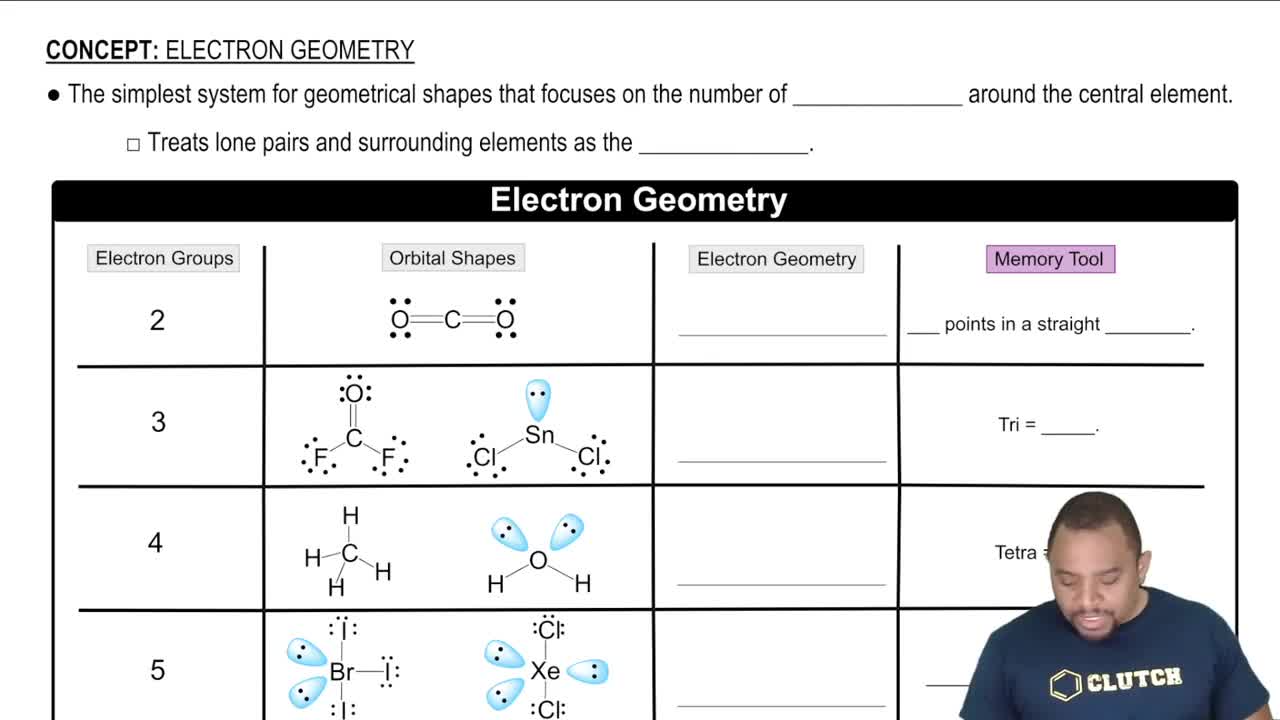
Electron Geometry

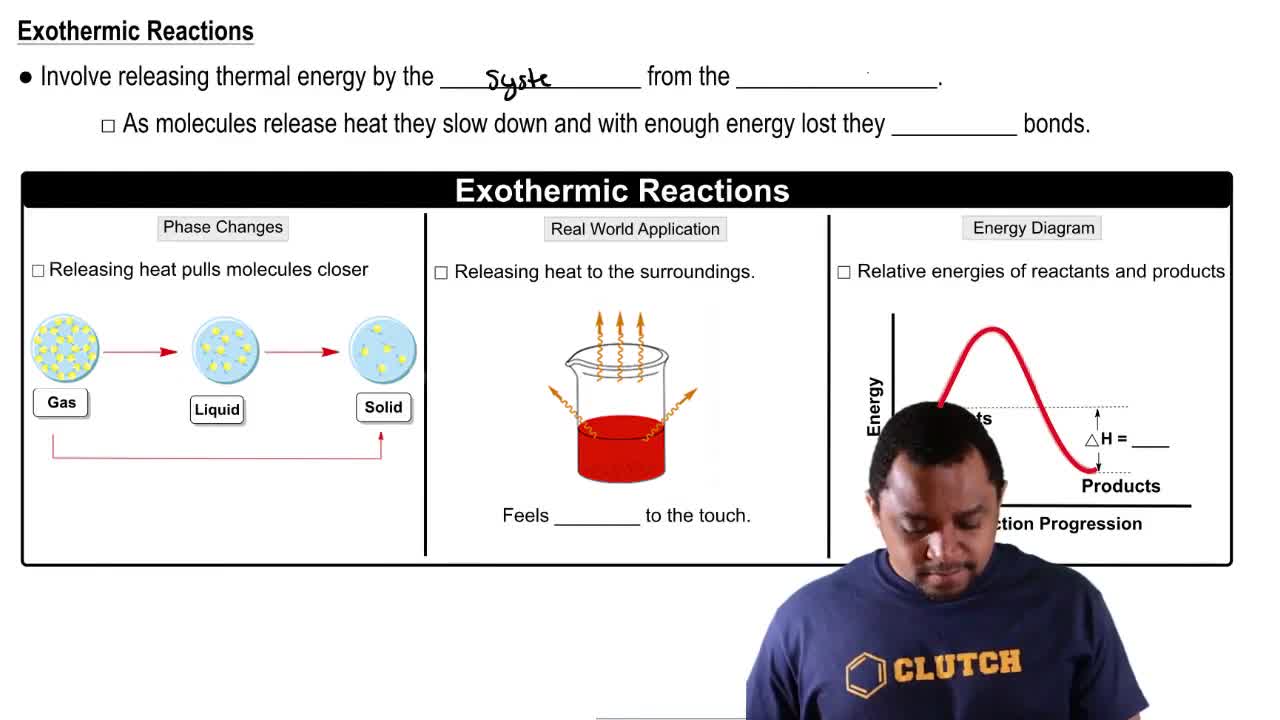
Exothermic Reactions

An exothermic reaction is a chemical reaction that releases energy, usually in the form of heat, to its surroundings. This occurs when the total energy of the products is lower than that of the reactants, indicating that energy is released during the formation of products. Determining whether the electron transfer process is exothermic involves evaluating the energy changes associated with the formation of ions.
추천 영상:
가이드 코스
02:38
Endothermic & Exothermic Reactions

Chlorine as a Nonmetal

Chlorine is a representative nonmetal that readily accepts electrons to form negatively charged ions (Cl⁻). Its high electronegativity makes it a strong oxidizing agent, which influences the energy dynamics of electron transfer reactions. Understanding chlorine's behavior in electron transfer is essential for predicting whether the process is exothermic or endothermic.
추천 영상:
가이드 코스
01:12
Nonmetal Properties