Ch.7 - Periodic Properties of the Elements
Brown - Chemistry: The Central Science 14th Edition
Brown14th EditionChemistry: The Central ScienceISBN: 9780134414232당신이 사용하는 게 아니라요?교과서 변경
7장, 문제 47

Give three examples of +2 ions that have an electron configuration of nd10 (n = 3, 4, 5...).

검증된 단계별 안내
1
Step 1: Understand that the problem is asking for +2 ions with a full d subshell, specifically with an electron configuration of nd^10.
Step 2: Recall that transition metals often form +2 ions by losing their s electrons first, followed by d electrons if necessary.
Step 3: Identify transition metals that have a d^10 configuration in their neutral state. These are typically found at the end of the d-block in each period.
Step 4: Consider the electron configurations of neutral transition metals like Zinc (Zn), Cadmium (Cd), and Mercury (Hg), which have a d^10 configuration in their neutral state.
Step 5: Recognize that when these metals form +2 ions, they lose their s electrons, resulting in a d^10 configuration for the ion. Therefore, Zn^2+, Cd^2+, and Hg^2+ are examples of +2 ions with a d^10 configuration.

주요 개념

질문에 올바르게 답하기 위해 반드시 이해해야 하는 핵심 개념들은 다음과 같습니다.

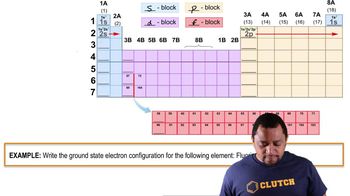
Electron Configuration

Electron configuration describes the distribution of electrons in an atom's orbitals. It is represented by a series of numbers and letters indicating the energy levels and sublevels occupied by electrons. For example, the notation 'nd10' indicates that the d subshell is fully filled with 10 electrons, which is characteristic of transition metals.
추천 영상:
가이드 코스
01:33
Electron Configuration Example

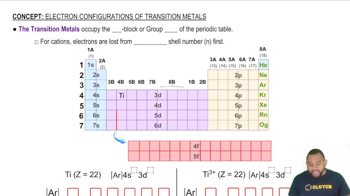
Transition Metals

Transition metals are elements found in the d-block of the periodic table, known for their ability to form variable oxidation states and colored compounds. They typically have partially filled d orbitals, but when they form +2 ions, they often lose their outermost s electrons first, leading to stable electron configurations such as nd10.
추천 영상:
가이드 코스
03:12
Transition Metals

Ionic Charge and Stability

Ionic charge refers to the net electrical charge an atom carries after losing or gaining electrons. A +2 ion indicates that the atom has lost two electrons, which can lead to a more stable electron configuration. For example, transition metals like copper (Cu) and zinc (Zn) can form +2 ions with a stable electron configuration of nd10, contributing to their chemical properties.
추천 영상:
가이드 코스
03:13
Intepreting the Band of Stability