Ch.7 - Periodic Properties of the Elements
Brown - Chemistry: The Central Science 14th Edition
Brown14th EditionChemistry: The Central ScienceISBN: 9780134414232당신이 사용하는 게 아니라요?교과서 변경
7장, 문제 44

For each of the following pairs, indicate which element has the smaller first ionization energy: (a) Cs, Cl (b) Fe, Zn (c) I, Cl (d) Se, Sn.

검증된 단계별 안내
1
Step 1: Understand the concept of first ionization energy, which is the energy required to remove the outermost electron from a neutral atom in the gaseous state.
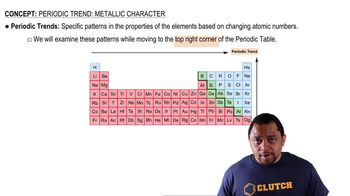
Step 2: Recall the periodic trend: Ionization energy generally increases across a period (left to right) and decreases down a group (top to bottom) in the periodic table.
Step 3: Analyze pair (a) Cs, Cl: Cesium (Cs) is in Group 1 and Chlorine (Cl) is in Group 17. Cs is further down the group compared to Cl, so Cs has a smaller first ionization energy.
Step 4: Analyze pair (b) Fe, Zn: Both Iron (Fe) and Zinc (Zn) are in the same period, but Zn is to the right of Fe. Therefore, Fe has a smaller first ionization energy.
Step 5: Analyze pair (c) I, Cl and (d) Se, Sn: For (c), Iodine (I) is below Chlorine (Cl) in Group 17, so I has a smaller first ionization energy. For (d), Selenium (Se) is above Tin (Sn) in the periodic table, so Sn has a smaller first ionization energy.

주요 개념

질문에 올바르게 답하기 위해 반드시 이해해야 하는 핵심 개념들은 다음과 같습니다.

Ionization Energy

Ionization energy is the energy required to remove an electron from an atom in its gaseous state. It is a key factor in determining an element's reactivity and is influenced by the atomic size and the effective nuclear charge. Generally, ionization energy increases across a period and decreases down a group in the periodic table.
추천 영상:
가이드 코스
01:19
Ionization Energy

Periodic Trends

Periodic trends refer to the predictable patterns observed in the properties of elements as you move across or down the periodic table. For ionization energy, elements on the right side of the table tend to have higher ionization energies than those on the left, while elements higher up in a group have higher ionization energies than those lower down due to increased electron shielding and distance from the nucleus.
추천 영상:
가이드 코스
00:38
Periodic Trends

Electron Configuration

Electron configuration describes the distribution of electrons in an atom's orbitals. The arrangement of electrons affects an atom's ionization energy; for example, elements with a stable electron configuration (like noble gases) have higher ionization energies. Understanding the electron configuration of the elements in the pairs helps predict which will have a lower ionization energy based on their stability and reactivity.
추천 영상:
가이드 코스
01:33
Electron Configuration Example