Ch.7 - Periodic Properties of the Elements
Brown - Chemistry: The Central Science 14th Edition
Brown14th EditionChemistry: The Central ScienceISBN: 9780134414232당신이 사용하는 게 아니라요?교과서 변경
7장, 문제 36b

In the ionic compounds LiF, NaCl, KBr, and RbI, the measured cation–anion distances are 201 pm (Li–F), 282 pm (Na–Cl), 330 pm (K–Br), and 367 pm (Rb–I), respectively. (b) Calculate the difference between the experimentally measured ion–ion distances and the ones predicted from Figure 7.8.
Table showing ionic radii of elements in pm for cations and anions in groups 1A, 2A, 3A, 6A, and 7A.

검증된 단계별 안내
1
Identify the ionic radii of the cations and anions from the provided table: Li+ (90 pm), Na+ (116 pm), K+ (152 pm), Rb+ (166 pm), F- (119 pm), Cl- (167 pm), Br- (182 pm), I- (206 pm).
Calculate the predicted ion–ion distances by adding the radii of the respective cations and anions: LiF (Li+ + F-), NaCl (Na+ + Cl-), KBr (K+ + Br-), RbI (Rb+ + I-).
Compare the experimentally measured ion–ion distances with the predicted distances: LiF (201 pm), NaCl (282 pm), KBr (330 pm), RbI (367 pm).
Determine the difference between the experimentally measured distances and the predicted distances for each compound.
Summarize the differences for each compound: LiF, NaCl, KBr, and RbI.

비슷한 문제에 대한 검증된 영상 답변:

이 영상 해법은 위 문제에 도움이 된다고 튜터들이 추천한 것입니다.
영상 길이:
3m

주요 개념

질문에 올바르게 답하기 위해 반드시 이해해야 하는 핵심 개념들은 다음과 같습니다.

Ionic Radii

Ionic radii refer to the effective size of an ion in a crystal lattice, which is influenced by its charge and the number of electrons. Cations, which are positively charged, are generally smaller than their neutral atoms due to the loss of electrons, while anions, negatively charged, are larger due to the addition of electrons. Understanding ionic radii is crucial for predicting the distances between ions in ionic compounds.
추천 영상:
가이드 코스
03:56
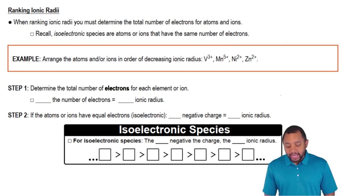
Ranking Ionic Radii

Cation-Anion Distances

Cation-anion distances are the measured distances between the centers of cations and anions in an ionic compound. These distances can be experimentally determined and are influenced by the sizes of the ions involved. Analyzing these distances helps in understanding the stability and structure of ionic compounds, as well as their physical properties.
추천 영상:
가이드 코스
00:31
Cation Solubility

Experimental vs. Predicted Values

In chemistry, comparing experimental values with predicted values allows for the validation of theoretical models. In this context, the predicted ion-ion distances can be derived from the ionic radii, while the experimental values are obtained through measurement. Discrepancies between these values can provide insights into the nature of ionic bonding and the arrangement of ions in the crystal lattice.
추천 영상:
가이드 코스
05:50
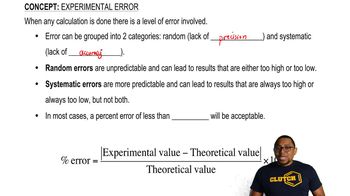
Experimental Error