Ch.8 - Basic Concepts of Chemical Bonding
Brown - Chemistry: The Central Science 14th Edition
Brown14th EditionChemistry: The Central ScienceISBN: 9780134414232당신이 사용하는 게 아니라요?교과서 변경
8장, 문제 3d

A portion of a two-dimensional 'slab' of NaCl(s) is shown here (see Figure 8.2) in which the ions are numbered. (d) Consider ion 5. How many repulsive interactions are shown for it?

검증된 단계별 안내
1
Identify the position of ion 5 in the NaCl lattice structure.
Recall that in a NaCl lattice, each ion is surrounded by ions of opposite charge, leading to attractive interactions, and ions of the same charge, leading to repulsive interactions.
Determine the number of ions with the same charge as ion 5 that are in close proximity to it. These are the ions that will have repulsive interactions with ion 5.
Count the number of these same-charge ions that are directly adjacent to ion 5 in the two-dimensional plane.
Conclude the number of repulsive interactions by considering only the nearest neighbors with the same charge as ion 5.

비슷한 문제에 대한 검증된 영상 답변:

이 영상 해법은 위 문제에 도움이 된다고 튜터들이 추천한 것입니다.
영상 길이:
1m

주요 개념

질문에 올바르게 답하기 위해 반드시 이해해야 하는 핵심 개념들은 다음과 같습니다.

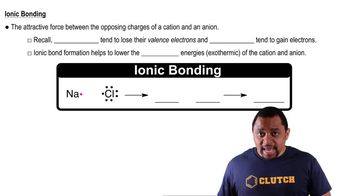
Ionic Bonding

Ionic bonding occurs when atoms transfer electrons, resulting in the formation of charged ions. In NaCl, sodium (Na) loses an electron to become Na+, while chlorine (Cl) gains an electron to become Cl-. The electrostatic attraction between these oppositely charged ions forms a strong ionic bond, creating a crystalline lattice structure characteristic of ionic compounds.
추천 영상:

Repulsive Interactions

Repulsive interactions in ionic compounds arise when like-charged ions are brought close together. These interactions occur due to the electrostatic forces that push ions apart, which is crucial for maintaining the stability of the crystal lattice. In the context of NaCl, each ion experiences repulsion from other ions of the same charge, affecting the overall structure and stability of the solid.
추천 영상:
가이드 코스
00:47
Valence Shell Electron Pair Repulsion Theory

Coordination Number

The coordination number refers to the number of nearest neighbor ions surrounding a given ion in a crystal lattice. In NaCl, each Na+ ion is surrounded by six Cl- ions and vice versa, leading to a coordination number of 6. Understanding the coordination number helps in analyzing the spatial arrangement of ions and the resulting interactions, including both attractive and repulsive forces.
추천 영상:
가이드 코스
00:27
Coordination Numbers