
Ch.8 - Basic Concepts of Chemical Bonding
Brown - Chemistry: The Central Science 14th Edition
Brown14th EditionChemistry: The Central ScienceISBN: 9780134414232당신이 사용하는 게 아니라요?교과서 변경
8장, 문제 96

An important reaction for the conversion of natural gas to other useful hydrocarbons is the conversion of methane to ethane. 2 CH4(g) → C2H6(g) + H2(g) In practice, this reaction is carried out in the presence of oxygen, which converts the hydrogen produced into water. 2 CH4(g) + 12 O2(g) → C2H6(g) + H2O(g) Use Table 8.3 to estimate H for these two reactions. Why is the conversion of methane to ethane more favorable when oxygen is used? Why is the conversion of methane to ethane more favorable when oxygen is used?

검증된 단계별 안내
1
Identify the two chemical reactions given in the problem. The first reaction is the conversion of methane to ethane and hydrogen: 2 CH_4(g) \(\rightarrow\) C_2H_6(g) + H_2(g). The second reaction includes oxygen and produces water instead of hydrogen: 2 CH_4(g) + 3 O_2(g) \(\rightarrow\) C_2H_6(g) + 2 H_2O(g).
Refer to Table 8.3 to find the standard enthalpy of formation (\(\Delta\) H_f^\(\circ\)) values for each reactant and product in both reactions. The values you need are for CH_4(g), C_2H_6(g), H_2(g), O_2(g), and H_2O(g).
Calculate the total enthalpy change (\(\Delta\) H) for each reaction using the formula: \(\Delta\) H = \(\sum\) (\(\Delta\) H_f^\(\circ\) \(\text{ of products}\)) - \(\sum\) (\(\Delta\) H_f^\(\circ\) \(\text{ of reactants}\)). Make sure to account for the stoichiometric coefficients in the reactions.
Compare the \(\Delta\) H values of the two reactions. A more negative \(\Delta\) H indicates a more exothermic reaction, which is generally more favorable in terms of energy efficiency.
Explain why the presence of oxygen makes the conversion of methane to ethane more favorable. Consider the enthalpy changes and the fact that converting hydrogen to water in the presence of oxygen releases additional energy, making the overall reaction more exothermic.

비슷한 문제에 대한 검증된 영상 답변:

이 영상 해법은 위 문제에 도움이 된다고 튜터들이 추천한 것입니다.
영상 길이:
3m

주요 개념

질문에 올바르게 답하기 위해 반드시 이해해야 하는 핵심 개념들은 다음과 같습니다.

Thermodynamics and Enthalpy Change (ΔH)

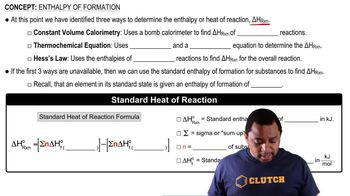
Thermodynamics is the study of energy transformations, and enthalpy change (ΔH) is a key concept that quantifies the heat absorbed or released during a chemical reaction. In the context of the given reactions, calculating ΔH helps determine the favorability of the conversion of methane to ethane. A negative ΔH indicates an exothermic reaction, which is generally more favorable as it releases energy, making the process more spontaneous.
추천 영상:
가이드 코스
02:34
Enthalpy of Formation

Reaction Mechanism and Catalysis

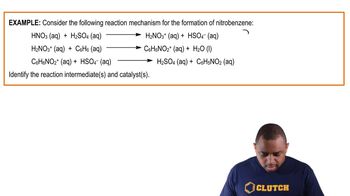
The reaction mechanism describes the step-by-step process by which reactants are converted into products. In the presence of oxygen, the reaction may proceed through a more efficient pathway, potentially involving catalytic effects that lower the activation energy. This can enhance the rate of conversion of methane to ethane, making the reaction more favorable under practical conditions.
추천 영상:
가이드 코스
02:14
Reaction Mechanism Example

Le Chatelier's Principle

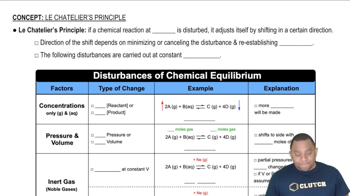
Le Chatelier's Principle states that if a dynamic equilibrium is disturbed by changing the conditions, the system will adjust to counteract the change and restore a new equilibrium. In the context of the methane to ethane conversion, the introduction of oxygen and the production of water can shift the equilibrium position, favoring the formation of ethane. This principle helps explain why the presence of oxygen makes the conversion more favorable.
추천 영상:
가이드 코스
07:32
Le Chatelier's Principle