Ch.8 - Basic Concepts of Chemical Bonding
Brown - Chemistry: The Central Science 14th Edition
Brown14th EditionChemistry: The Central ScienceISBN: 9780134414232당신이 사용하는 게 아니라요?교과서 변경
8장, 문제 40a,b

By referring only to the periodic table, select (a) the most electronegative element in group 13; (b) the least electronegative element in the group As, Se and Br;

검증된 단계별 안내
1
Step 1: Understand the concept of electronegativity. Electronegativity is a measure of an atom's ability to attract and hold onto electrons. It generally increases across a period and decreases down a group in the periodic table.
Step 2: Locate group 13 on the periodic table. Group 13 elements include B (Boron), Al (Aluminum), Ga (Gallium), In (Indium), and Tl (Thallium). Electronegativity tends to decrease as you move down the group.
Step 3: Identify the most electronegative element in group 13. Since electronegativity decreases down the group, the element at the top of the group, Boron (B), is the most electronegative.
Step 4: Compare the electronegativities of As (Arsenic), Se (Selenium), and Br (Bromine). These elements are located in different groups and periods, so refer to their positions on the periodic table to determine their relative electronegativities.
Step 5: Determine the least electronegative element among As, Se, and Br. Electronegativity generally increases across a period, so the element furthest to the left (As) is typically the least electronegative.

비슷한 문제에 대한 검증된 영상 답변:

이 영상 해법은 위 문제에 도움이 된다고 튜터들이 추천한 것입니다.
영상 길이:
1m
도움이 되었나요?

주요 개념

질문에 올바르게 답하기 위해 반드시 이해해야 하는 핵심 개념들은 다음과 같습니다.

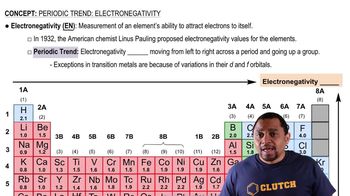
Electronegativity

Electronegativity is a measure of an atom's ability to attract and hold onto electrons in a chemical bond. It is a key factor in determining how atoms interact with each other, influencing bond polarity and molecular structure. The electronegativity values are often referenced from the Pauling scale, where higher values indicate a stronger tendency to attract electrons.
추천 영상:
가이드 코스
02:10
Electronegativity Trends

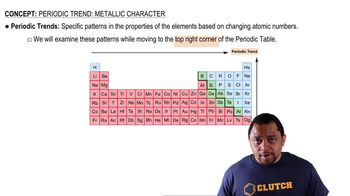
Periodic Trends

Periodic trends refer to the predictable patterns observed in the properties of elements as you move across or down the periodic table. Electronegativity generally increases across a period from left to right and decreases down a group. Understanding these trends helps in predicting the behavior of elements, including their reactivity and bonding characteristics.
추천 영상:
가이드 코스
00:38
Periodic Trends

Group 13 Elements

Group 13 of the periodic table includes elements such as boron, aluminum, gallium, indium, and thallium. These elements exhibit unique properties, including varying electronegativities. In this group, boron is the most electronegative element, while the other elements show decreasing electronegativity as you move down the group, which is essential for answering questions related to their chemical behavior.
추천 영상:
가이드 코스
00:50
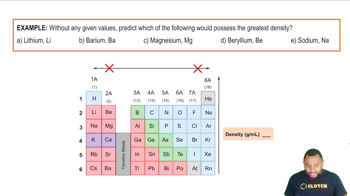
Main Group Elements: Density Example