Ch.8 - Basic Concepts of Chemical Bonding
Brown - Chemistry: The Central Science 14th Edition
Brown14th EditionChemistry: The Central ScienceISBN: 9780134414232당신이 사용하는 게 아니라요?교과서 변경
8장, 문제 37

Which of the following statements about electronegativity is false? (a) Electronegativity is the ability of an atom in a molecule to attract electron density toward itself. (b) Electronegativity is the same thing as electron affinity. (c) The numerical values for electronegativity have no units. (d) Fluorine is the most electronegative element. (e) Cesium is the least electronegative element.

검증된 단계별 안내
1
Step 1: Understand the concept of electronegativity. Electronegativity is a measure of the ability of an atom in a molecule to attract electrons to itself. It is a key concept in understanding the nature of chemical bonds.
Step 2: Compare the given statements with the definition and properties of electronegativity. Statement (a) is true as it correctly defines electronegativity.
Step 3: Understand the difference between electronegativity and electron affinity. Electron affinity is the energy change that occurs when an electron is added to a neutral atom, while electronegativity is the ability of an atom to attract electrons. Therefore, statement (b) is false.
Step 4: Electronegativity is a dimensionless quantity, meaning it has no units. So, statement (c) is true.
Step 5: Fluorine is the most electronegative element and cesium is the least electronegative element on the periodic table. Therefore, statements (d) and (e) are also true.

비슷한 문제에 대한 검증된 영상 답변:

이 영상 해법은 위 문제에 도움이 된다고 튜터들이 추천한 것입니다.
영상 길이:
4m
도움이 되었나요?

주요 개념

질문에 올바르게 답하기 위해 반드시 이해해야 하는 핵심 개념들은 다음과 같습니다.

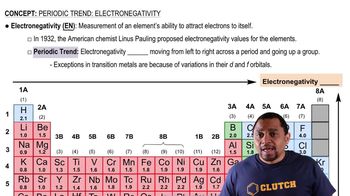
Electronegativity

Electronegativity is a measure of an atom's ability to attract and hold onto electron density in a chemical bond. It is a relative scale, with values assigned to elements based on their tendency to attract electrons. The most electronegative element is fluorine, which has the highest value on the Pauling scale, indicating its strong ability to pull electron density towards itself.
추천 영상:
가이드 코스
02:10
Electronegativity Trends

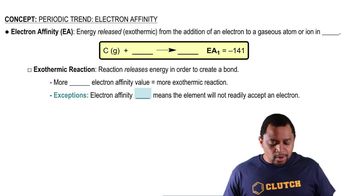
Electron Affinity

Electron affinity refers to the energy change that occurs when an electron is added to a neutral atom in the gas phase, resulting in the formation of a negative ion. While both electronegativity and electron affinity involve the attraction of electrons, they are distinct concepts; electronegativity pertains to an atom's behavior in a bond, while electron affinity measures the energy change associated with gaining an electron.
추천 영상:
가이드 코스
01:34
Electron Affinity

Units of Measurement

Electronegativity values are dimensionless and do not have units, as they are based on a relative scale rather than an absolute measurement. This means that electronegativity is expressed as a number that indicates the strength of an atom's attraction for electrons compared to other elements, allowing for easy comparison without the need for specific units.
추천 영상:
가이드 코스
02:52
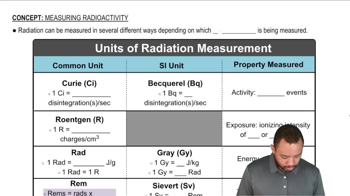
Units of Radiation Measurement