
Consider the formate ion, HCO2-, which is the anion formed when formic acid loses an H+ ion. The H and the two O atoms are bonded to the central C atom. (c) Would you predict that the C—O bond lengths in the formate ion would be longer or shorter relative to those in CO2?
Ch.8 - Basic Concepts of Chemical Bonding
8장, 문제 55
Predict the ordering, from shortest to longest, of the bond lengths in CO, CO2, and CO32- .
검증된 단계별 안내1
Identify the types of bonds in each molecule or ion. CO has a triple bond, CO2 has two double bonds between carbon and oxygen, and CO32- (carbonate ion) has resonance structures typically represented with one double bond and two single bonds between carbon and oxygen.
Recall that generally, triple bonds are shorter than double bonds, and double bonds are shorter than single bonds due to the increasing number of shared electrons pulling the bonded atoms closer together.
Consider the effect of resonance in CO32-. Resonance can cause the actual bond lengths to be an average of the different forms, potentially making the bonds in CO32- shorter than a typical single bond but not as short as a double bond.
Compare the bond types and the effects of resonance to predict the relative bond lengths. Since CO has a triple bond, it should have the shortest bond length. CO2 with double bonds should have a longer bond length than CO but shorter than CO32-.
Order the molecules and ion from shortest to longest bond length based on the analysis: CO (shortest), CO2, CO32- (longest).

비슷한 문제에 대한 검증된 영상 답변:
이 영상 해법은 위 문제에 도움이 된다고 튜터들이 추천한 것입니다.
영상 길이:
5m도움이 되었나요?
주요 개념
질문에 올바르게 답하기 위해 반드시 이해해야 하는 핵심 개념들은 다음과 같습니다.
Bond Length
Bond length is the distance between the nuclei of two bonded atoms. It is influenced by the type of bond (single, double, or triple) and the size of the atoms involved. Generally, shorter bonds correspond to stronger interactions between atoms, while longer bonds indicate weaker interactions.
추천 영상:
가이드 코스
Average Bond Order
Bond Order
Bond order refers to the number of chemical bonds between a pair of atoms. It is calculated as the difference between the number of bonding and antibonding electrons divided by two. Higher bond orders typically result in shorter bond lengths due to increased electron density between the nuclei, leading to stronger attractions.
추천 영상:
가이드 코스
Average Bond Order
Resonance Structures
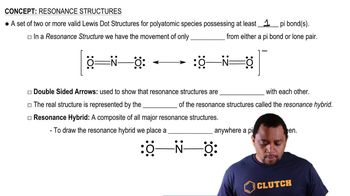
Resonance structures are different ways of drawing the same molecule that illustrate the delocalization of electrons. In molecules like CO3^2-, resonance indicates that the actual bond lengths are an average of the different structures. This delocalization can affect bond lengths, making them longer than expected for a single bond but shorter than for a double bond.
추천 영상:
가이드 코스
Resonance Structures
관련 실천
교과서 질문
1
views
교과서 질문
Mothballs are composed of naphthalene, C10H8, a molecule that consists of two six-membered rings of carbon fused along an edge, as shown in this incomplete Lewis structure:(a) Draw all of the resonance structures of naphthalene. How many are there?
762
views
교과서 질문
(c) What would you predict for the lengths of the bonds in NO2- relative to N¬O single bonds and double bonds?
교과서 질문
Based on Lewis structures, predict the ordering, from shortest to longest, of N¬O bond lengths in NO+, NO2-, and NO3-.
1530
views
1
comments
교과서 질문
Consider the formate ion, HCO2-, which is the anion formed when formic acid loses an H+ ion. The H and the two O atoms are bonded to the central C atom. (b) Are resonance structures needed to describe the structure?
1830
views
