Ch.8 - Basic Concepts of Chemical Bonding
Brown - Chemistry: The Central Science 14th Edition
Brown14th EditionChemistry: The Central ScienceISBN: 9780134414232당신이 사용하는 게 아니라요?교과서 변경
8장, 문제 85b

Consider the collection of nonmetallic elements O, P, Te, I, and B. (b) Which two would form the longest single bond?

검증된 단계별 안내
1
insert step 1> Identify the elements in the problem: O (Oxygen), P (Phosphorus), Te (Tellurium), I (Iodine), and B (Boron).
insert step 2> Recall that the length of a single bond between two atoms is influenced by the size of the atoms involved. Larger atoms tend to form longer bonds.
insert step 3> Consider the periodic trends: Atomic size increases as you move down a group in the periodic table and decreases as you move across a period from left to right.
insert step 4> Compare the atomic sizes of the given elements. Te and I are in the same period and are larger than O, P, and B, which are in higher periods.
insert step 5> Conclude that the longest single bond would likely be between the two largest atoms, which are Te and I.

비슷한 문제에 대한 검증된 영상 답변:

이 영상 해법은 위 문제에 도움이 된다고 튜터들이 추천한 것입니다.
영상 길이:
59s
도움이 되었나요?

주요 개념

질문에 올바르게 답하기 위해 반드시 이해해야 하는 핵심 개념들은 다음과 같습니다.

Bond Length

Bond length is the distance between the nuclei of two bonded atoms. It is influenced by the size of the atoms and the type of bond formed (single, double, or triple). Generally, single bonds are longer than double or triple bonds, and larger atoms tend to form longer bonds due to their increased atomic radii.
추천 영상:
가이드 코스
00:36
Average Bond Order

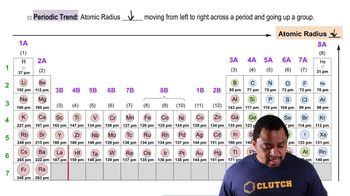
Atomic Size and Trends

Atomic size refers to the distance from the nucleus to the outermost electrons. In the periodic table, atomic size increases down a group and decreases across a period. Nonmetals like oxygen and iodine have different atomic sizes, which affects the bond length when they form bonds with each other.
추천 영상:
가이드 코스
01:42
Atomic Radius Trends

Types of Bonds

The type of bond formed between two elements can significantly affect bond length. Single bonds, formed by the sharing of one pair of electrons, are generally longer than double or triple bonds. In the context of nonmetals, the nature of the bond (e.g., covalent) and the specific elements involved will determine the bond length.
추천 영상:
관련 실천
교과서 질문

Consider the collection of nonmetallic elements O, P, Te, I, and B. (a) Which two would form the most polar single bond?

413
views

교과서 질문

The substance chlorine monoxide, ClO(g), is important in atmospheric processes that lead to depletion of the ozone layer. The ClO molecule has an experimental dipole moment of 1.24 D, and the Cl—O bond length is 160 pm. (c) Using formal charges as a guide, propose the dominant Lewis structure for the molecule. (g), is important in atmospheric processes that lead to depletion of the ozone layer. The ClO molecule has an experimental dipole moment of 1.24 D, and the Cl—O bond length is 160 pm. (d) The anion ClO exists. What is the formal charge on the Cl for the best Lewis structure for ClO-?

1
views
교과서 질문

Construct a Born–Haber cycle for the formation of the hypothetical compound NaCl2, where the sodium ion has a 2+ charge (the second ionization energy for sodium is given in Table 7.2). (a) How large would the lattice energy need to be for the formation of NaCl2 to be exothermic?

1104
views
교과서 질문

Consider the collection of nonmetallic elements: B, As, O, and I. (d) Which element would likely to participate in two covalent bonds?

1
views
교과서 질문

The substance chlorine monoxide, ClO(g), is important in atmospheric processes that lead to depletion of the ozone layer. The ClO molecule has an experimental dipole moment of 1.24 D, and the Cl—O bond length is 160 pm. (b) Based on the electronegativities of the elements, which atom would you expect to have a partial negative charge in the ClO molecule?

987
views