Ch.8 - Basic Concepts of Chemical Bonding
Brown - Chemistry: The Central Science 14th Edition
Brown14th EditionChemistry: The Central ScienceISBN: 9780134414232당신이 사용하는 게 아니라요?교과서 변경
8장, 문제 85d

Consider the collection of nonmetallic elements: B, As, O, and I. (d) Which element would likely to participate in two covalent bonds?

검증된 단계별 안내
1
First, understand the concept of covalent bonding. Covalent bonds involve the sharing of electron pairs between atoms. Nonmetals typically form covalent bonds by sharing electrons to achieve a full valence shell, often resembling the electron configuration of noble gases.
Next, consider the valence electrons of each element. The number of covalent bonds an element can form is often related to the number of electrons needed to complete its valence shell. For example, oxygen (O) has 6 valence electrons and needs 2 more to complete its octet, making it likely to form two covalent bonds.
Examine the electron configuration of each element: - Boron (B) has 3 valence electrons. - Arsenic (As) has 5 valence electrons. - Oxygen (O) has 6 valence electrons. - Iodine (I) has 7 valence electrons.
Identify the element that needs two additional electrons to complete its valence shell. Oxygen, with 6 valence electrons, needs 2 more electrons to achieve a stable octet configuration, making it likely to form two covalent bonds.
Conclude that oxygen (O) is the element most likely to participate in two covalent bonds due to its need to gain two electrons to complete its octet.

비슷한 문제에 대한 검증된 영상 답변:

이 영상 해법은 위 문제에 도움이 된다고 튜터들이 추천한 것입니다.
영상 길이:
3m
도움이 되었나요?

주요 개념

질문에 올바르게 답하기 위해 반드시 이해해야 하는 핵심 개념들은 다음과 같습니다.

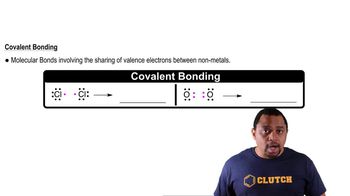
Covalent Bonding

Covalent bonding occurs when two atoms share one or more pairs of electrons, allowing them to achieve a more stable electron configuration. Nonmetals, which typically have high electronegativities, tend to form covalent bonds with other nonmetals. The number of covalent bonds an element can form is often determined by its valence electrons and its ability to share them with other atoms.
추천 영상:

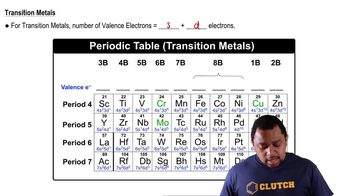
Valence Electrons

Valence electrons are the outermost electrons of an atom and are crucial in determining how an element interacts with others. The number of valence electrons influences an element's bonding behavior; for instance, elements with four or more valence electrons can form multiple covalent bonds. Understanding the valence electron configuration of the elements in question helps predict their bonding capabilities.
추천 영상:
가이드 코스
02:12
Transition Metals Valence Electrons

Nonmetallic Elements

Nonmetals are elements that typically lack the characteristics of metals, such as conductivity and malleability. They are found on the right side of the periodic table and often have high electronegativities, which allows them to form covalent bonds. Nonmetals like boron (B) and oxygen (O) can form multiple bonds due to their electron configurations, making them key players in covalent bonding scenarios.
추천 영상:
가이드 코스
02:35
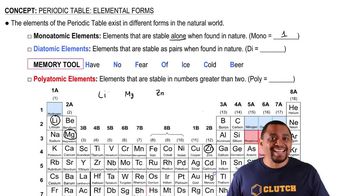
Elemental Forms of Elements