
Ch.8 - Basic Concepts of Chemical Bonding
Brown - Chemistry: The Central Science 14th Edition
Brown14th EditionChemistry: The Central ScienceISBN: 9780134414232당신이 사용하는 게 아니라요?교과서 변경
8장, 문제 25a

Consider the ionic compounds KF, NaCl, NaBr, and LiCl. (a) Use ionic radii (Figure 7.8) to estimate the cation–anion distance for each compound.

검증된 단계별 안내
1
Identify the cations and anions in each compound: KF (K^+ and F^-), NaCl (Na^+ and Cl^-), NaBr (Na^+ and Br^-), LiCl (Li^+ and Cl^-).
Refer to Figure 7.8 or a reliable source to find the ionic radii for each ion: K^+, Na^+, Li^+, F^-, Cl^-, and Br^-.
For each compound, add the ionic radius of the cation to the ionic radius of the anion to estimate the cation–anion distance.
Express the cation–anion distance in appropriate units, typically in picometers (pm) or angstroms (Å).
Compare the estimated distances to understand how ionic size affects the structure of these compounds.

비슷한 문제에 대한 검증된 영상 답변:

이 영상 해법은 위 문제에 도움이 된다고 튜터들이 추천한 것입니다.
영상 길이:
3m
도움이 되었나요?

주요 개념

질문에 올바르게 답하기 위해 반드시 이해해야 하는 핵심 개념들은 다음과 같습니다.

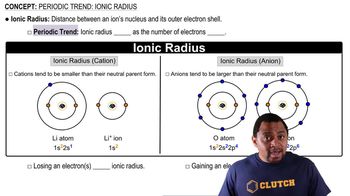
Ionic Radius

Ionic radius refers to the size of an ion in a crystal lattice. Cations (positively charged ions) are typically smaller than their neutral atoms due to the loss of electrons, while anions (negatively charged ions) are larger due to the gain of electrons. Understanding ionic radii is crucial for estimating the distances between cations and anions in ionic compounds.
추천 영상:

Cation-Anion Distance

The cation-anion distance is the distance between the centers of a cation and an anion in an ionic compound. This distance can be estimated by adding the ionic radii of the respective cation and anion. Accurate estimation of this distance is important for understanding the properties of ionic compounds, such as lattice energy and stability.
추천 영상:
가이드 코스
00:31
Cation Solubility

Lattice Energy

Lattice energy is the energy released when gaseous ions combine to form an ionic solid. It is influenced by the charges of the ions and the distance between them, as described by Coulomb's law. A greater cation-anion distance typically results in lower lattice energy, affecting the compound's melting point and solubility.
추천 영상:
관련 실천
교과서 질문

Energy is required to remove two electrons from Ca to form Ca2+, and energy is required to add two electrons to O to form O2 - . Yet CaO is stable relative to the free elements. Which statement is the best explanation? (a) The lattice energy of CaO is large enough to overcome these processes. (b) CaO is a covalent compound, and these processes are irrelevant. (c) CaO has a higher molar mass than either Ca or O. (d) The enthalpy of formation of CaO is small. (e) CaO is stable to atmospheric conditions.

1093
views
교과서 질문

(a) Does the lattice energy of an ionic solid increase or decrease (i) as the charges of the ions increase, (ii) as the sizes of the ions increase?

807
views
교과서 질문

Which of the following trends in lattice energy is due to differences in ionic radii? (a) LiF > NaF > CsF, (b) CaO > KCl, (c) PbS > Li2O.

764
views
교과서 질문

Consider the ionic compounds KF, NaCl, NaBr, and LiCl. (b) Based on your answer to part (a), arrange these four compounds in order of decreasing lattice energy. (c) Check your predictions in part (b) with the experimental values of lattice energy from Table 8.1. Are the predictions from ionic radii correct?

1
views
교과서 질문

(b) Arrange the following substances not listed in Table 8.1 according to their expected lattice energies, listing them from lowest lattice energy to the highest: MgS, KI, GaN, LiBr.

교과서 질문

The substances NaF and CaO are isoelectronic (have the same number of valence electrons). (d) Using the lattice energies in Table 8.1, predict the lattice energy of ScN.

897
views