

Ch.8 - Basic Concepts of Chemical Bonding
Brown - Chemistry: The Central Science 14th Edition
Brown14th EditionChemistry: The Central ScienceISBN: 9780134414232당신이 사용하는 게 아니라요?교과서 변경
8장, 문제 25b,c

Consider the ionic compounds KF, NaCl, NaBr, and LiCl. (b) Based on your answer to part (a), arrange these four compounds in order of decreasing lattice energy. (c) Check your predictions in part (b) with the experimental values of lattice energy from Table 8.1. Are the predictions from ionic radii correct?

검증된 단계별 안내
1
To arrange the ionic compounds in order of decreasing lattice energy, we need to consider the factors that affect lattice energy: the charges of the ions and the distance between them (ionic radii). Lattice energy is directly proportional to the product of the charges and inversely proportional to the distance between the ions.
Since all the compounds have ions with charges of +1 and -1, the charge factor is the same for all. Therefore, we focus on the ionic radii. Smaller ions will have higher lattice energies because they can get closer together, increasing the electrostatic attraction.
Compare the ionic radii of the cations: Li⁺, Na⁺, and K⁺. Li⁺ has the smallest radius, followed by Na⁺, and then K⁺. For the anions, F⁻ is smaller than Cl⁻ and Br⁻.
Based on ionic radii, predict the order of decreasing lattice energy: LiCl (smallest cation and anion combination), NaCl, NaBr, and KF (largest cation and anion combination).
To verify the predictions, compare them with experimental lattice energy values from Table 8.1. Check if the order based on ionic radii matches the experimental data, and note any discrepancies.

비슷한 문제에 대한 검증된 영상 답변:

이 영상 해법은 위 문제에 도움이 된다고 튜터들이 추천한 것입니다.
영상 길이:
2m
도움이 되었나요?

주요 개념

질문에 올바르게 답하기 위해 반드시 이해해야 하는 핵심 개념들은 다음과 같습니다.

Lattice Energy

Lattice energy is the energy released when gaseous ions combine to form an ionic solid. It is a measure of the strength of the forces between the ions in an ionic compound. Higher lattice energy indicates stronger ionic bonds, which typically results from smaller ionic radii and higher charges on the ions. Understanding lattice energy is crucial for predicting the stability and solubility of ionic compounds.
추천 영상:

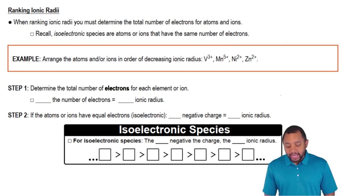
Ionic Radii

Ionic radii refer to the effective size of an ion in a crystal lattice. The size of the ions affects the distance between them, which in turn influences the lattice energy. Generally, smaller ions lead to stronger attractions and higher lattice energies. Recognizing the trends in ionic radii, such as cation size decreasing across a period and anion size increasing down a group, is essential for comparing the lattice energies of different ionic compounds.
추천 영상:
가이드 코스
03:56
Ranking Ionic Radii

Trends in Lattice Energy

The trends in lattice energy can be predicted based on the charges and sizes of the ions involved. Compounds with ions of higher charges and smaller radii typically exhibit greater lattice energies. For example, comparing KF, NaCl, NaBr, and LiCl, one can analyze the ionic charges and sizes to predict their lattice energies. Understanding these trends allows for a systematic approach to arranging compounds by their lattice energies.
추천 영상: