
In the following pairs of binary compounds, determine which one is a molecular substance and which one is an ionic substance. Use the appropriate naming convention (for ionic or molecular substances) to assign a name to each compound: (a) TiCl4 and CaF2 (b) ClF3 and VF3
Ch.8 - Basic Concepts of Chemical Bonding
8장, 문제 45
In the following pairs of binary compounds, determine which one is a molecular substance and which one is an ionic substance. Use the appropriate naming convention (for ionic or molecular substances) to assign a name to each compound: (a) SiF4 and LaF3 (for ionic or molecular substances) to assign a name to each compound: (b) FeCl2 and ReCl6 (c) PbCl4 and RbCl.
검증된 단계별 안내1
Identify the types of elements in each compound: PbCl4 contains lead (Pb) and chlorine (Cl), while RbCl contains rubidium (Rb) and chlorine (Cl). Lead is a metal and chlorine is a nonmetal; similarly, rubidium is a metal and chlorine is a nonmetal.
Determine the type of bonding and compound classification: Metals bonding with nonmetals typically form ionic compounds due to the transfer of electrons from the metal to the nonmetal. Therefore, both PbCl4 and RbCl are likely to be ionic compounds.
Check the nature of the metal: Pb (lead) can form more than one type of ion (Pb2+ and Pb4+), which is typical in ionic compounds with transition and post-transition metals. Rb (rubidium) forms a single type of ion (Rb+), typical of alkali metals in ionic compounds.
Assign the correct names using ionic naming conventions: For PbCl4, since lead can have multiple oxidation states, specify the oxidation state of lead in the name. For RbCl, rubidium forms only one common ion, so no specification of the charge is needed.
Final names: PbCl4 is named lead(IV) chloride, indicating that lead is in the +4 oxidation state. RbCl is named rubidium chloride, indicating the +1 oxidation state of rubidium.

비슷한 문제에 대한 검증된 영상 답변:
이 영상 해법은 위 문제에 도움이 된다고 튜터들이 추천한 것입니다.
영상 길이:
7m도움이 되었나요?
주요 개념
질문에 올바르게 답하기 위해 반드시 이해해야 하는 핵심 개념들은 다음과 같습니다.
Ionic vs. Molecular Compounds
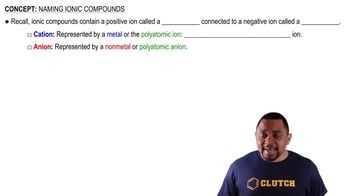
Ionic compounds are formed from the electrostatic attraction between positively and negatively charged ions, typically between metals and nonmetals. In contrast, molecular compounds consist of molecules formed by covalent bonds, where atoms share electrons, usually between nonmetals. Understanding the distinction helps in identifying the nature of the compounds in question.
추천 영상:
가이드 코스
Ionic Compounds Naming
Naming Ionic Compounds
Ionic compounds are named by stating the cation (positive ion) first, followed by the anion (negative ion). The cation retains its elemental name, while the anion's name is derived from its element with an '-ide' suffix for simple ions. For example, in RbCl, rubidium (Rb) is the cation and chlorine (Cl) becomes chloride.
추천 영상:
가이드 코스
Ionic Compounds Naming
Naming Molecular Compounds
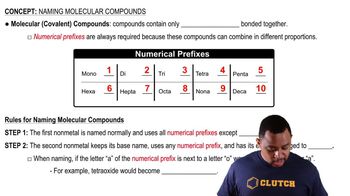
Molecular compounds are named using prefixes to indicate the number of atoms of each element present in the molecule. The first element retains its name, while the second element's name is modified to include an '-ide' suffix. For instance, PbCl4 is named lead(IV) chloride, indicating the presence of four chloride ions associated with lead.
추천 영상:
가이드 코스
Naming Molecular Compounds
관련 실천
교과서 질문
844
views
교과서 질문
(b) If you were to put HBr under very high pressure, so its bond length decreased significantly, would its dipole moment increase, decrease, or stay the same, if you assume that the effective charges on the atoms do not change?
821
views
교과서 질문
(a) From the data in Table 8.2, calculate the effective charges on the H atom of the HBr molecule in units of the electronic charge, e.
2145
views
1
comments
교과서 질문
In the following pairs of binary compounds, determine which one is a molecular substance and which one is an ionic substance. Use the appropriate naming convention (for ionic or molecular substances) to assign a name to each compound: (c) SbCl5 and AlF3.
1021
views
교과서 질문
The iodine monobromide molecule, IBr, has a bond length
of 249 pm and a dipole moment of 1.21 D. (a) Which atom of
the molecule is expected to have a negative charge?
1344
views
교과서 질문
Draw Lewis structures for the following: (a) CH2Cl2 (b) ClCN (c) SF2
617
views
