
Ch.8 - Basic Concepts of Chemical Bonding
Brown - Chemistry: The Central Science 14th Edition
Brown14th EditionChemistry: The Central ScienceISBN: 9780134414232당신이 사용하는 게 아니라요?교과서 변경
8장, 문제 44

The iodine monobromide molecule, IBr, has a bond length of 249 pm and a dipole moment of 1.21 D. (a) Which atom of the molecule is expected to have a negative charge?

검증된 단계별 안내
1
Identify the atoms in the IBr molecule: iodine (I) and bromine (Br).
Recall that the dipole moment is a measure of the separation of positive and negative charges in a molecule.
Understand that the dipole moment points from the positive to the negative charge.
Consider the electronegativity of the atoms: Bromine (Br) is more electronegative than iodine (I).
Conclude that the more electronegative atom, bromine (Br), will have a partial negative charge, while iodine (I) will have a partial positive charge.

비슷한 문제에 대한 검증된 영상 답변:

이 영상 해법은 위 문제에 도움이 된다고 튜터들이 추천한 것입니다.
영상 길이:
55s

주요 개념

질문에 올바르게 답하기 위해 반드시 이해해야 하는 핵심 개념들은 다음과 같습니다.

Electronegativity

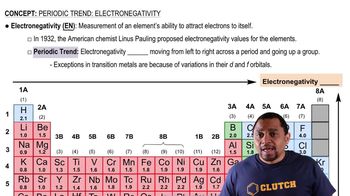
Electronegativity is a measure of an atom's ability to attract and hold onto electrons in a chemical bond. In the case of IBr, iodine (I) is less electronegative than bromine (Br), meaning that Br will attract the shared electrons more strongly, leading to a partial negative charge on the bromine atom.
추천 영상:
가이드 코스
02:10
Electronegativity Trends

Dipole Moment

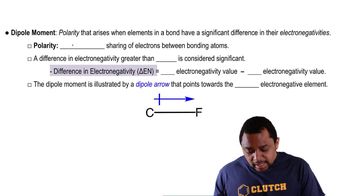
The dipole moment is a vector quantity that represents the separation of positive and negative charges in a molecule. It is calculated as the product of the charge and the distance between the charges. In IBr, the dipole moment of 1.21 D indicates that there is an uneven distribution of electron density, confirming that one atom carries a partial negative charge.
추천 영상:

Bond Polarity

Bond polarity refers to the distribution of electrical charge over the atoms joined by the bond. In IBr, the difference in electronegativity between bromine and iodine results in a polar covalent bond, where bromine becomes partially negative and iodine partially positive, leading to the overall dipole moment observed in the molecule.
추천 영상:
가이드 코스
02:38
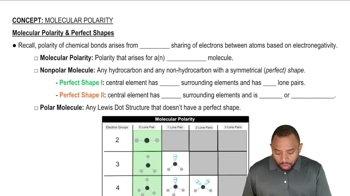
Molecular Polarity
관련 실천
교과서 질문

In the following pairs of binary compounds, determine which one is a molecular substance and which one is an ionic substance. Use the appropriate naming convention (for ionic or molecular substances) to assign a name to each compound: (a) TiCl4 and CaF2 (b) ClF3 and VF3

844
views
교과서 질문

Arrange the bonds in each of the following sets in order of increasing polarity: (c) C—S, B—F, N—O.

697
views
교과서 질문

(b) If you were to put HBr under very high pressure, so its bond length decreased significantly, would its dipole moment increase, decrease, or stay the same, if you assume that the effective charges on the atoms do not change?

821
views
교과서 질문

(a) From the data in Table 8.2, calculate the effective charges on the H atom of the HBr molecule in units of the electronic charge, e.

2145
views
1
comments
교과서 질문

In the following pairs of binary compounds, determine which one is a molecular substance and which one is an ionic substance. Use the appropriate naming convention (for ionic or molecular substances) to assign a name to each compound: (c) SbCl5 and AlF3.

1021
views
교과서 질문

In the following pairs of binary compounds, determine which one is a molecular substance and which one is an ionic substance. Use the appropriate naming convention (for ionic or molecular substances) to assign a name to each compound: (a) SiF4 and LaF3 (for ionic or molecular substances) to assign a name to each compound: (b) FeCl2 and ReCl6 (c) PbCl4 and RbCl.

550
views