
Ch.8 - Basic Concepts of Chemical Bonding
Brown - Chemistry: The Central Science 14th Edition
Brown14th EditionChemistry: The Central ScienceISBN: 9780134414232당신이 사용하는 게 아니라요?교과서 변경
8장, 문제 7a

The partial Lewis structure that follows is for a hydrocarbon molecule. In the full Lewis structure, each carbon atom satisfies the octet rule, and there are no unshared electron pairs in the molecule. The carbon—carbon bonds are labeled 1, 2, and 3. (a) How many hydrogen atoms are in the molecule?

검증된 단계별 안내
1
Identify the number of carbon atoms in the given partial Lewis structure.
Recall that each carbon atom forms four bonds to satisfy the octet rule.
Determine the number of bonds each carbon atom forms with other carbon atoms and with hydrogen atoms.
Calculate the total number of hydrogen atoms needed by considering the remaining bonds each carbon atom can form after accounting for carbon-carbon bonds.
Ensure that the total number of bonds for each carbon atom equals four, confirming the number of hydrogen atoms.

비슷한 문제에 대한 검증된 영상 답변:

이 영상 해법은 위 문제에 도움이 된다고 튜터들이 추천한 것입니다.
영상 길이:
1m
도움이 되었나요?

주요 개념

질문에 올바르게 답하기 위해 반드시 이해해야 하는 핵심 개념들은 다음과 같습니다.

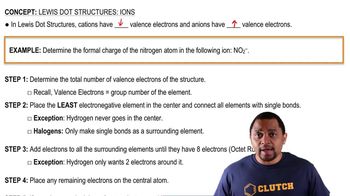
Lewis Structures

Lewis structures are diagrams that represent the bonding between atoms in a molecule and the lone pairs of electrons that may exist. They help visualize how atoms are connected and how many electrons are shared or unshared. In hydrocarbons, carbon atoms typically form four bonds, and hydrogen atoms form one bond, which is crucial for determining the molecular formula.
추천 영상:
가이드 코스
04:28
Lewis Dot Structures: Ions

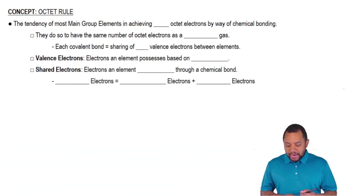
Octet Rule

The octet rule is a chemical rule of thumb that states atoms tend to bond in such a way that they each have eight electrons in their valence shell, achieving a stable electron configuration similar to that of noble gases. For carbon, this means it can form four bonds, while hydrogen, with only one valence electron, can form one bond to achieve a stable configuration.
추천 영상:

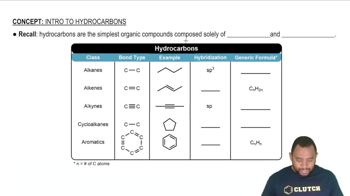
Hydrocarbons

Hydrocarbons are organic compounds consisting entirely of hydrogen and carbon. They can be classified as aliphatic (straight or branched chains) or aromatic (ring structures). The number of hydrogen atoms in a hydrocarbon can be determined based on the number of carbon atoms and the types of bonds (single, double, or triple) present, following specific formulas for saturated and unsaturated hydrocarbons.
추천 영상:
가이드 코스
04:29
Intro To Hydrocarbons