
Ch.8 - Basic Concepts of Chemical Bonding
Brown - Chemistry: The Central Science 14th Edition
Brown14th EditionChemistry: The Central ScienceISBN: 9780134414232당신이 사용하는 게 아니라요?교과서 변경
8장, 문제 23b

The substances NaF and CaO are isoelectronic (have the same number of valence electrons). (b) What are the charges of each of the anions in each compound?

검증된 단계별 안내
1
Identify the elements in each compound: NaF consists of sodium (Na) and fluorine (F), while CaO consists of calcium (Ca) and oxygen (O).
Determine the common oxidation states of these elements: Na typically has a +1 charge, F typically has a -1 charge, Ca typically has a +2 charge, and O typically has a -2 charge.
Analyze the compounds to determine the charge of the anions: In NaF, F is the anion and in CaO, O is the anion.
Apply the concept of neutrality in compounds: The total charge in the compound must be zero, so the charge of the anion must balance the charge of the cation.
Conclude the charges of the anions: In NaF, the anion F has a charge of -1 to balance Na's +1. In CaO, the anion O has a charge of -2 to balance Ca's +2.

비슷한 문제에 대한 검증된 영상 답변:

이 영상 해법은 위 문제에 도움이 된다고 튜터들이 추천한 것입니다.
영상 길이:
53s

주요 개념

질문에 올바르게 답하기 위해 반드시 이해해야 하는 핵심 개념들은 다음과 같습니다.

Isoelectronic Species

Isoelectronic species are atoms, ions, or molecules that have the same number of electrons and, consequently, the same electronic structure. In the case of NaF and CaO, both compounds have ions that achieve a stable electron configuration similar to noble gases, which is crucial for understanding their chemical behavior and bonding.
추천 영상:
가이드 코스
03:03
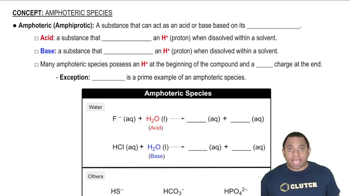
Amphoteric Species

Valence Electrons

Valence electrons are the outermost electrons of an atom and are involved in chemical bonding. The number of valence electrons determines how an atom interacts with others, including the formation of ions. In NaF, sodium (Na) has one valence electron, while fluorine (F) has seven, leading to the formation of Na+ and F- ions.
추천 영상:
가이드 코스
02:12
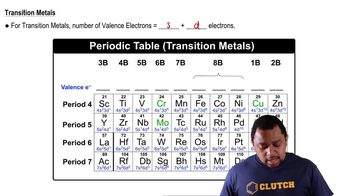
Transition Metals Valence Electrons

Ionic Charges

Ionic charges refer to the positive or negative charge that an atom acquires when it loses or gains electrons. In NaF, sodium loses one electron to become Na+, while fluorine gains one electron to become F-. In CaO, calcium (Ca) loses two electrons to form Ca2+, and oxygen (O) gains two electrons to form O2-, resulting in the respective charges of the anions in each compound.
추천 영상: