Ch.8 - Basic Concepts of Chemical Bonding
Brown - Chemistry: The Central Science 14th Edition
Brown14th EditionChemistry: The Central ScienceISBN: 9780134414232당신이 사용하는 게 아니라요?교과서 변경
8장, 문제 106a

Under special conditions, sulfur reacts with anhydrous liquid ammonia to form a binary compound of sulfur and nitrogen. The compound is found to consist of 69.6% S and 30.4% N. Measurements of its molecular mass yield a value of 184.3 g/mol. The compound occasionally detonates on being struck or when heated rapidly. The sulfur and nitrogen atoms of the molecule are joined in a ring. All the bonds in the ring are of the same length. (a) Calculate the empirical and molecular formulas for the substance.

검증된 단계별 안내
1
Determine the molar mass of sulfur (S) and nitrogen (N). Sulfur has a molar mass of approximately 32.07 g/mol, and nitrogen has a molar mass of approximately 14.01 g/mol.
Calculate the moles of sulfur and nitrogen in 100 g of the compound using the percentage composition. For sulfur, use the formula: moles of S = mass of S / molar mass of S. For nitrogen, use the formula: moles of N = mass of N / molar mass of N.
Find the simplest whole number ratio of moles of sulfur to moles of nitrogen by dividing each by the smallest number of moles calculated in the previous step.
Write the empirical formula using the whole number mole ratios of sulfur and nitrogen obtained. This formula represents the simplest whole-number ratio of atoms in the compound.
Calculate the molecular formula by comparing the empirical formula mass to the given molecular mass (184.3 g/mol). Divide the molecular mass by the mass of the empirical formula to find the number of empirical units per molecule, and multiply the subscripts in the empirical formula by this number.

비슷한 문제에 대한 검증된 영상 답변:

이 영상 해법은 위 문제에 도움이 된다고 튜터들이 추천한 것입니다.
영상 길이:
4m
도움이 되었나요?

주요 개념

질문에 올바르게 답하기 위해 반드시 이해해야 하는 핵심 개념들은 다음과 같습니다.

Empirical Formula

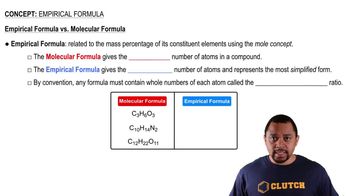
The empirical formula represents the simplest whole-number ratio of the elements in a compound. To determine it, one must convert the percentage composition of each element into moles, then simplify the ratio of these moles to the smallest whole numbers. In this case, with 69.6% sulfur and 30.4% nitrogen, the empirical formula can be calculated by finding the moles of each element and simplifying their ratio.
추천 영상:
가이드 코스
02:26
Empirical vs Molecular Formula

Molecular Formula

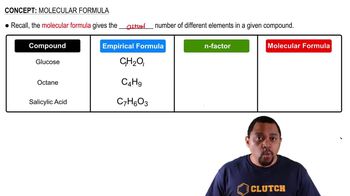
The molecular formula indicates the actual number of atoms of each element in a molecule of a compound. It can be derived from the empirical formula by comparing the molar mass of the compound to the molar mass of the empirical formula. Given the molecular mass of 184.3 g/mol, one can determine how many times the empirical formula fits into this mass to find the molecular formula.
추천 영상:
가이드 코스
02:08
Determining Molecular Formulas

Chemical Bonding and Structure

Understanding chemical bonding is crucial for analyzing the structure of a compound. In this case, the description of sulfur and nitrogen atoms forming a ring with equal bond lengths suggests a stable cyclic structure, likely involving resonance or delocalized electrons. This concept helps explain the compound's stability and reactivity, particularly its tendency to detonate under certain conditions.
추천 영상:
관련 실천
교과서 질문

A common form of elemental phosphorus is the tetrahedral P4 molecule, where all four phosphorus atoms are equivalent: 

(b) How many P-P bonds are there in the molecule?

765
views

교과서 질문

Acetylene (C2H2) and nitrogen (N2) both contain a triple bond, but they differ greatly in their chemical properties. (c) Write balanced chemical equations for the complete oxidation of N2 to form N2O5(g) and of acetylene to form CO2(g) and H2O(g). Write a balanced chemical equation for the complete oxidation of acetylene to form CO2(g) and H2O(g).

350
views
교과서 질문

A common form of elemental phosphorus is the tetrahedral P4 molecule, where all four phosphorus atoms are equivalent: 

Draw a Lewis structure for a linear P4 molecule that satisfies the octet rule. Does this molecule have resonance structures?

1243
views
교과서 질문

Acetylene (C2H2) and nitrogen (N2) both contain a triple bond, but they differ greatly in their chemical properties. (e) Both N2 and C2H2 possess triple bonds with quite high bond enthalpies (Table 8.3). Calculate the enthalpy of hydrogenation per mole for both compounds: acetylene plus H2 to make methane, CH4; nitrogen plus H2 to make ammonia, NH3.

교과서 질문

Under special conditions, sulfur reacts with anhydrous liquid ammonia to form a binary compound of sulfur and nitrogen. The compound is found to consist of 69.6% S and 30.4% N. Measurements of its molecular mass yield a value of 184.3 g/mol. The compound occasionally detonates on being struck or when heated rapidly. The sulfur and nitrogen atoms of the molecule are joined in a ring. All the bonds in the ring are of the same length. (b) Write Lewis structures for the molecule, based on the information you are given. (Hint: You should find a relatively small number of dominant Lewis structures.)

교과서 질문

Acetylene (C2H2) and nitrogen (N2) both contain a triple bond, but they differ greatly in their chemical properties. (d) Calculate the enthalpy of oxidation per mole for N2 and for C2H2 (the enthalpy of formation of N2O5(g) is 11.30 kJ/mol).