Ch.8 - Basic Concepts of Chemical Bonding
Brown - Chemistry: The Central Science 14th Edition
Brown14th EditionChemistry: The Central ScienceISBN: 9780134414232당신이 사용하는 게 아니라요?교과서 변경
8장, 문제 105e

Acetylene (C2H2) and nitrogen (N2) both contain a triple bond, but they differ greatly in their chemical properties. (e) Both N2 and C2H2 possess triple bonds with quite high bond enthalpies (Table 8.3). Calculate the enthalpy of hydrogenation per mole for both compounds: acetylene plus H2 to make methane, CH4; nitrogen plus H2 to make ammonia, NH3.

검증된 단계별 안내
1
Identify the chemical reactions for the hydrogenation of acetylene and nitrogen. For acetylene: \( \text{C}_2\text{H}_2 + 2\text{H}_2 \rightarrow \text{CH}_4 \). For nitrogen: \( \text{N}_2 + 3\text{H}_2 \rightarrow 2\text{NH}_3 \).
Determine the bond enthalpies for each bond involved in the reactions. Use a table of bond enthalpies to find the values for C≡C, C-H, N≡N, and N-H bonds.
Calculate the total bond enthalpies for the reactants in each reaction. For acetylene, consider the C≡C bond and the H-H bonds. For nitrogen, consider the N≡N bond and the H-H bonds.
Calculate the total bond enthalpies for the products in each reaction. For acetylene, consider the C-H bonds in methane. For nitrogen, consider the N-H bonds in ammonia.
Use the formula for enthalpy change: \( \Delta H = \text{Total bond enthalpies of reactants} - \text{Total bond enthalpies of products} \) to find the enthalpy of hydrogenation per mole for both reactions.

비슷한 문제에 대한 검증된 영상 답변:

이 영상 해법은 위 문제에 도움이 된다고 튜터들이 추천한 것입니다.
영상 길이:
3m
도움이 되었나요?

주요 개념

질문에 올바르게 답하기 위해 반드시 이해해야 하는 핵심 개념들은 다음과 같습니다.

Triple Bonds

A triple bond is a type of chemical bond where three pairs of electrons are shared between two atoms, resulting in a strong interaction. In acetylene (C2H2), the triple bond between carbon atoms contributes to its reactivity and unique properties. In contrast, nitrogen (N2) has a triple bond that makes it very stable and inert under standard conditions, affecting its chemical behavior.
추천 영상:
가이드 코스
00:59
Bond Order and Type of Bond

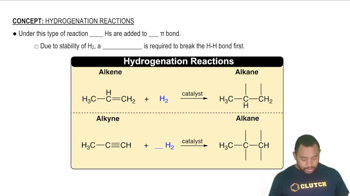
Enthalpy of Hydrogenation

The enthalpy of hydrogenation refers to the heat change that occurs when a compound reacts with hydrogen to form a saturated compound. This value is crucial for understanding the stability of the original compound; a more negative enthalpy indicates a more exothermic reaction and thus a more stable product. For acetylene and nitrogen, calculating this enthalpy helps compare their reactivity and the energy changes involved in their hydrogenation.
추천 영상:
가이드 코스
01:22
Hydrogenation Reactions

Bond Enthalpy

Bond enthalpy is the measure of the strength of a chemical bond, defined as the energy required to break one mole of bonds in a gaseous substance. High bond enthalpies, like those found in triple bonds, indicate strong bonds that are less likely to break during reactions. Understanding bond enthalpy is essential for calculating the enthalpy changes during reactions, such as the hydrogenation of acetylene and nitrogen.
추천 영상:
가이드 코스
02:34
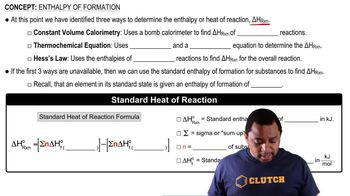
Enthalpy of Formation
관련 실천
교과서 질문

A common form of elemental phosphorus is the tetrahedral P4 molecule, where all four phosphorus atoms are equivalent: 

(b) How many P-P bonds are there in the molecule?

765
views

교과서 질문

Acetylene (C2H2) and nitrogen (N2) both contain a triple bond, but they differ greatly in their chemical properties. (c) Write balanced chemical equations for the complete oxidation of N2 to form N2O5(g) and of acetylene to form CO2(g) and H2O(g). Write a balanced chemical equation for the complete oxidation of acetylene to form CO2(g) and H2O(g).

350
views
교과서 질문

Acetylene (C2H2) and nitrogen (N2) both contain a triple bond, but they differ greatly in their chemical properties. (b) By referring to Appendix C, look up the enthalpies of formation of acetylene and nitrogen. Which compound is more stable?

344
views
교과서 질문

Under special conditions, sulfur reacts with anhydrous liquid ammonia to form a binary compound of sulfur and nitrogen. The compound is found to consist of 69.6% S and 30.4% N. Measurements of its molecular mass yield a value of 184.3 g/mol. The compound occasionally detonates on being struck or when heated rapidly. The sulfur and nitrogen atoms of the molecule are joined in a ring. All the bonds in the ring are of the same length. (b) Write Lewis structures for the molecule, based on the information you are given. (Hint: You should find a relatively small number of dominant Lewis structures.)

교과서 질문

Acetylene (C2H2) and nitrogen (N2) both contain a triple bond, but they differ greatly in their chemical properties. (d) Calculate the enthalpy of oxidation per mole for N2 and for C2H2 (the enthalpy of formation of N2O5(g) is 11.30 kJ/mol).

교과서 질문

Under special conditions, sulfur reacts with anhydrous liquid ammonia to form a binary compound of sulfur and nitrogen. The compound is found to consist of 69.6% S and 30.4% N. Measurements of its molecular mass yield a value of 184.3 g/mol. The compound occasionally detonates on being struck or when heated rapidly. The sulfur and nitrogen atoms of the molecule are joined in a ring. All the bonds in the ring are of the same length. (a) Calculate the empirical and molecular formulas for the substance.

1291
views