
Ch.8 - Basic Concepts of Chemical Bonding
Brown - Chemistry: The Central Science 14th Edition
Brown14th EditionChemistry: The Central ScienceISBN: 9780134414232당신이 사용하는 게 아니라요?교과서 변경
8장, 문제 32

Which of these elements are unlikely to form ionic bonds: Mg, Al, Si, Br, I?

검증된 단계별 안내
1
Step 1: Understand the nature of ionic bonds. Ionic bonds are formed between metals and non-metals where electrons are transferred from the metal to the non-metal, resulting in the formation of positively charged cations and negatively charged anions.
Step 2: Identify the elements given in the problem. The elements are Mg (Magnesium), Al (Aluminum), Si (Silicon), Br (Bromine), and I (Iodine).
Step 3: Classify each element as a metal, non-metal, or metalloid. Mg and Al are metals, Si is a metalloid, and Br and I are non-metals.
Step 4: Determine the likelihood of each element forming ionic bonds. Metals like Mg and Al tend to lose electrons and form cations, making them likely to form ionic bonds with non-metals. Non-metals like Br and I tend to gain electrons and form anions, also making them likely to form ionic bonds with metals.
Step 5: Consider the metalloid Si. Metalloids have properties intermediate between metals and non-metals and are less likely to form ionic bonds. Instead, they often form covalent bonds. Therefore, Si is unlikely to form ionic bonds.

주요 개념

질문에 올바르게 답하기 위해 반드시 이해해야 하는 핵심 개념들은 다음과 같습니다.

Ionic Bonds

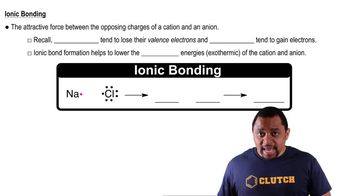
Ionic bonds are formed when one atom donates an electron to another, resulting in the creation of positively and negatively charged ions. This typically occurs between metals, which lose electrons, and nonmetals, which gain electrons. The electrostatic attraction between these oppositely charged ions holds them together in a compound.
추천 영상:

Electronegativity

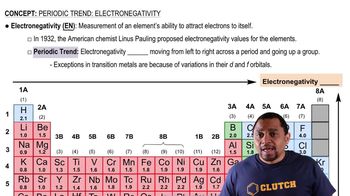
Electronegativity is a measure of an atom's ability to attract and hold onto electrons in a chemical bond. Elements with high electronegativity, such as nonmetals, are more likely to gain electrons and form ionic bonds with metals. Conversely, elements with low electronegativity are less likely to form ionic bonds, as they do not readily accept electrons.
추천 영상:
가이드 코스
02:10
Electronegativity Trends

Metallic vs. Nonmetallic Character

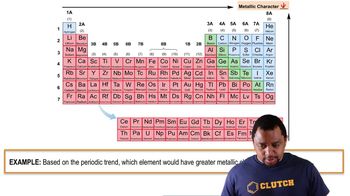
The metallic character of an element refers to its tendency to lose electrons and form positive ions, while nonmetallic character indicates a tendency to gain electrons. Metals like magnesium (Mg) and aluminum (Al) are more likely to form ionic bonds due to their metallic nature, whereas elements like silicon (Si), bromine (Br), and iodine (I) exhibit more nonmetallic characteristics, making them less likely to form ionic bonds.
추천 영상:
가이드 코스
00:56
Metallic Character Example