Ch.9 - Molecular Geometry and Bonding Theories
Brown - Chemistry: The Central Science 14th Edition
Brown14th EditionChemistry: The Central ScienceISBN: 9780134414232당신이 사용하는 게 아니라요?교과서 변경
9장, 문제 69

(a) What is the difference between hybrid orbitals and molecular orbitals? (b) How many electrons can be placed into each molecular orbital (MO) of a molecule? (c) Can antibonding molecular orbitals have electrons in them?

검증된 단계별 안내
1
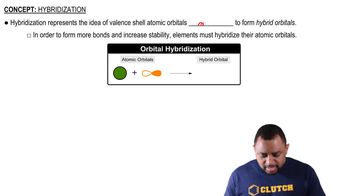
Step 1: Understand the concept of hybrid orbitals. Hybrid orbitals are formed by the combination of atomic orbitals within a single atom. This process is called hybridization, and it helps explain the geometry of molecular bonding. For example, in methane (CH₄), the carbon atom undergoes sp³ hybridization to form four equivalent hybrid orbitals.
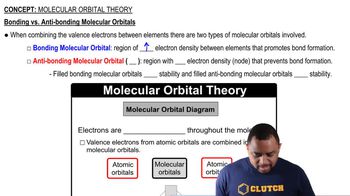
Step 2: Understand the concept of molecular orbitals. Molecular orbitals (MOs) are formed by the combination of atomic orbitals from different atoms in a molecule. These orbitals belong to the entire molecule rather than a single atom. MOs can be bonding, antibonding, or non-bonding, depending on the phase relationship of the combining atomic orbitals.
Step 3: Determine how many electrons can be placed into each molecular orbital. According to the Pauli Exclusion Principle, each molecular orbital can hold a maximum of two electrons with opposite spins.
Step 4: Explore whether antibonding molecular orbitals can have electrons. Antibonding molecular orbitals, denoted as σ* or π*, can indeed have electrons. However, electrons in these orbitals can weaken or destabilize the bond between atoms because they are higher in energy compared to bonding orbitals.
Step 5: Summarize the key differences and properties. Hybrid orbitals are localized on a single atom and explain molecular geometry, while molecular orbitals are delocalized over the entire molecule and explain bonding interactions. Each MO can hold two electrons, and antibonding MOs can contain electrons, affecting the stability of the molecule.

주요 개념

질문에 올바르게 답하기 위해 반드시 이해해야 하는 핵심 개념들은 다음과 같습니다.

Hybrid Orbitals

Hybrid orbitals are formed by the combination of atomic orbitals from the same atom to create new orbitals that are degenerate in energy and oriented to minimize electron repulsion. This concept is crucial for understanding molecular geometry and bonding in covalent compounds, as hybridization allows for the formation of bonds with specific angles, such as in sp3, sp2, and sp hybridizations.
추천 영상:

Molecular Orbitals

Molecular orbitals (MOs) are formed by the linear combination of atomic orbitals (LCAO) from different atoms in a molecule. These orbitals can be bonding, antibonding, or non-bonding, and they describe the distribution of electrons in a molecule. Understanding MOs is essential for predicting the stability and reactivity of molecules, as well as their electronic properties.
추천 영상:
가이드 코스
03:06
Molecular Orbital Theory

Electron Capacity of Molecular Orbitals

Each molecular orbital can hold a maximum of two electrons with opposite spins, according to the Pauli exclusion principle. The filling of MOs follows Hund's rule and the Aufbau principle, which dictate that electrons occupy the lowest energy orbitals first before pairing up. This concept is vital for determining the electron configuration of molecules and understanding their chemical behavior.
추천 영상:
가이드 코스
03:06
Molecular Orbital Theory