Consider the following XF4 ions: PF4-, BrF4-, ClF4+, and AlF4-. (a) Which of the ions have more than an octet of electrons around the central atom?
Ch.9 - Molecular Geometry and Bonding Theories
9장, 문제 86b
An AB2 molecule is described as having a tetrahedral geometry. (b) Based on the information given, which of the following is the molecular geometry of the molecule: (i) linear, (ii) bent, (iii) trigonal planar, or (iv) tetrahedral?
검증된 단계별 안내1
Step 1: Understand the molecular geometry. The molecular geometry of a molecule describes the three-dimensional shape of the atoms that make up a molecule. It is determined by the number of bonding pairs and lone pairs around the central atom.
Step 2: Identify the central atom. In an AB2 molecule, the central atom is 'A', and it is bonded to two 'B' atoms.
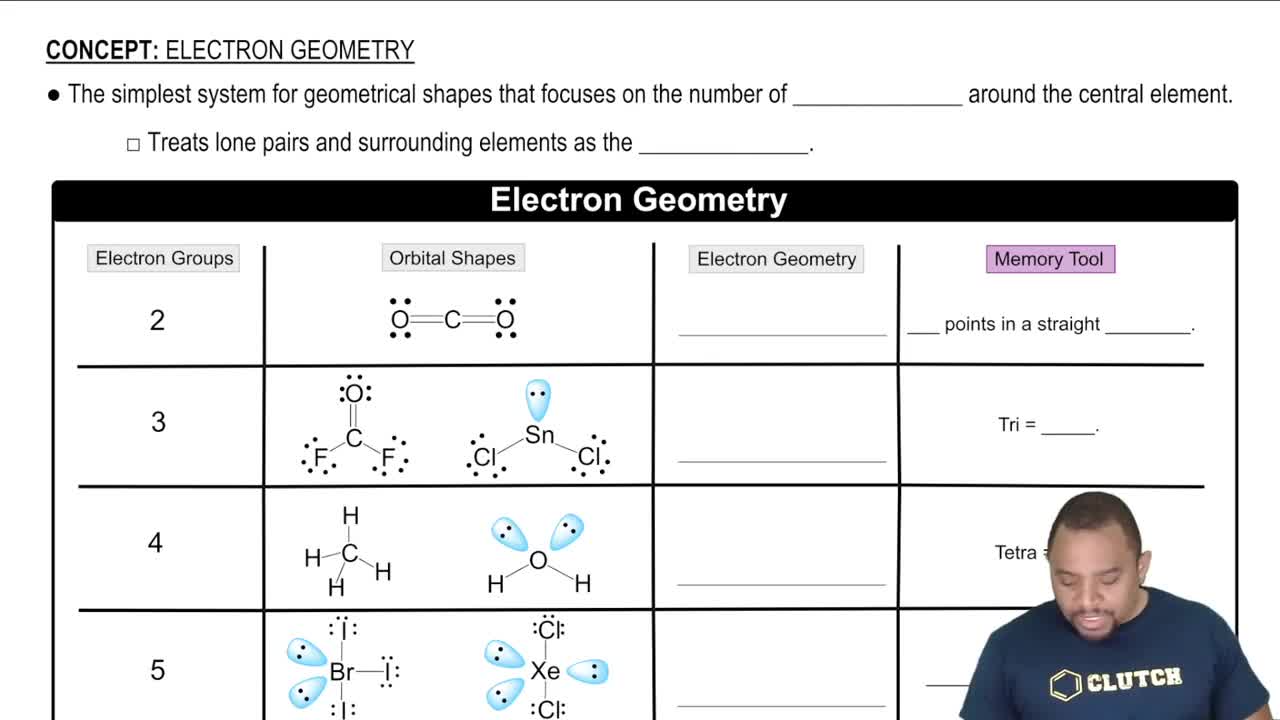
Step 3: Understand the tetrahedral geometry. A tetrahedral geometry means that the molecule is shaped like a tetrahedron, with the central atom at the center and the other atoms at the corners. In a tetrahedral molecule, there are four electron pairs around the central atom, which are arranged in such a way to minimize repulsion.
Step 4: Apply the information to the given molecule. The AB2 molecule is described as having a tetrahedral geometry. This means that in addition to the two 'B' atoms, there must be two lone pairs of electrons on the 'A' atom to make up the four electron pairs required for a tetrahedral geometry.
Step 5: Determine the molecular geometry. The molecular geometry is determined by the positions of the atoms, not the electron pairs. Therefore, the molecular geometry of the AB2 molecule is 'bent' or 'V-shaped', because the two 'B' atoms and the 'A' atom form a bent shape, while the two lone pairs of electrons on the 'A' atom do not contribute to the shape of the molecule.

비슷한 문제에 대한 검증된 영상 답변:
이 영상 해법은 위 문제에 도움이 된다고 튜터들이 추천한 것입니다.
영상 길이:
1m도움이 되었나요?
주요 개념
질문에 올바르게 답하기 위해 반드시 이해해야 하는 핵심 개념들은 다음과 같습니다.
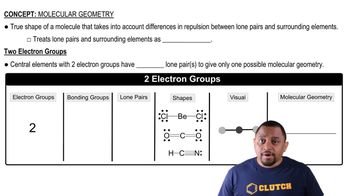
Molecular Geometry
Molecular geometry refers to the three-dimensional arrangement of atoms within a molecule. It is determined by the number of bonding pairs and lone pairs of electrons around the central atom, which influences the shape of the molecule. Understanding molecular geometry is crucial for predicting the physical and chemical properties of substances.
추천 영상:
가이드 코스
Molecular Geometry with Two Electron Groups
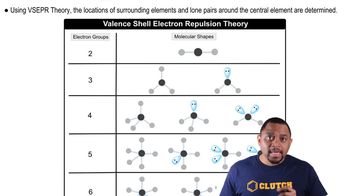
VSEPR Theory
Valence Shell Electron Pair Repulsion (VSEPR) theory is a model used to predict the geometry of molecules based on the repulsion between electron pairs. According to VSEPR, electron pairs will arrange themselves to minimize repulsion, leading to specific molecular shapes. This theory helps explain why certain molecules adopt geometries like tetrahedral or bent.
추천 영상:
가이드 코스
Molecular Shapes and VSEPR
Tetrahedral Geometry
Tetrahedral geometry occurs when a central atom is bonded to four other atoms, with bond angles of approximately 109.5 degrees. This arrangement is typical for molecules with four bonding pairs and no lone pairs, such as methane (CH4). In the context of the question, recognizing that an AB2 molecule with tetrahedral geometry implies a specific arrangement is key to determining its molecular geometry.
추천 영상:
가이드 코스
Electron Geometry
관련 실천
교과서 질문
862
views
교과서 질문
An AB2 molecule is described as having a tetrahedral geometry. (a) How many nonbonding domains are on atom A?
2921
views
교과서 질문
Consider the following XF4 ions: PF4-, BrF4-, ClF4+, and AlF4-. (c) Which of the ions will have an octahedral electron-domain geometry?
1139
views
교과서 질문
Consider the following XF4 ions: PF4-, BrF4-, ClF4+, and AlF4-. (b) For which of the ions will the electron-domain and molecular geometries be the same?
교과서 질문
The iodine bromide molecule, IBr, is an interhalogen compound. Assume that the molecular orbitals of IBr are analogous to the homonuclear diatomic molecule F2. (c) One of the valence MOs of IBr is sketched here. Why are the atomic orbital contributions to this MO different in size?
915
views