Ch.9 - Molecular Geometry and Bonding Theories
Brown - Chemistry: The Central Science 14th Edition
Brown14th EditionChemistry: The Central ScienceISBN: 9780134414232당신이 사용하는 게 아니라요?교과서 변경
9장, 문제 84c

The iodine bromide molecule, IBr, is an interhalogen compound. Assume that the molecular orbitals of IBr are analogous to the homonuclear diatomic molecule F2. (c) One of the valence MOs of IBr is sketched here. Why are the atomic orbital contributions to this MO different in size?
Molecular orbital diagram of iodine bromide (IBr) showing differing sizes of atomic orbital contributions.

검증된 단계별 안내
1
Identify the atomic orbitals involved in the formation of the molecular orbital (MO) of IBr.
Recall that iodine (I) and bromine (Br) have different electronegativities and atomic sizes.
Understand that the atomic orbital of the more electronegative atom (Br) will have a greater contribution to the bonding MO.
Note that the larger atomic orbital in the MO diagram corresponds to the less electronegative atom (I), which has a larger atomic size.
Conclude that the difference in size of the atomic orbital contributions in the MO is due to the difference in electronegativity and atomic size between iodine and bromine.

비슷한 문제에 대한 검증된 영상 답변:

이 영상 해법은 위 문제에 도움이 된다고 튜터들이 추천한 것입니다.
영상 길이:
1m
도움이 되었나요?

주요 개념

질문에 올바르게 답하기 위해 반드시 이해해야 하는 핵심 개념들은 다음과 같습니다.

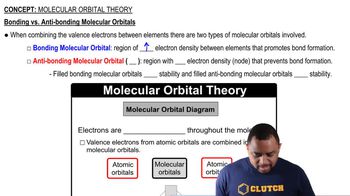
Molecular Orbitals (MOs)

Molecular orbitals are formed by the linear combination of atomic orbitals (LCAO) when atoms bond. In heteronuclear diatomic molecules like IBr, the differing electronegativities of the constituent atoms lead to MOs that have unequal contributions from each atom's atomic orbitals. This results in MOs that are not symmetrically distributed, affecting their size and shape.
추천 영상:
가이드 코스
03:06
Molecular Orbital Theory

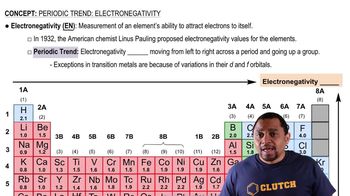
Electronegativity

Electronegativity is a measure of an atom's ability to attract and hold onto electrons. In IBr, iodine is less electronegative than bromine, which influences the distribution of electron density in the molecular orbitals. This difference in electronegativity leads to unequal contributions of the atomic orbitals to the MOs, resulting in one side of the MO being larger than the other.
추천 영상:
가이드 코스
02:10
Electronegativity Trends

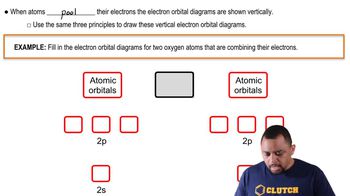
Atomic Orbital Size and Shape

The size and shape of atomic orbitals are determined by the principal quantum number and the type of orbital (s, p, d, etc.). In IBr, the atomic orbitals of iodine and bromine differ in size due to their respective atomic radii and electron configurations. This difference affects how much each atom contributes to the molecular orbital, leading to the observed asymmetry in the MO diagram.
추천 영상:
가이드 코스
01:51
Atomic Orbitals Example