Ch.9 - Molecular Geometry and Bonding Theories
Brown - Chemistry: The Central Science 14th Edition
Brown14th EditionChemistry: The Central ScienceISBN: 9780134414232당신이 사용하는 게 아니라요?교과서 변경
9장, 문제 56b

(b) Imagine that you could hold two atoms that are bonded together, twist them, and not change the bond length. Would it be easier to twist (rotate) around a single s bond or around a double 1s plus p2 bond, or would they be the same?
Lewis dot structures of ethane and ethene, illustrating single and double bonds.

검증된 단계별 안내
1
Identify the types of bonds in ethane and ethene. Ethane has a single bond (sigma bond) between the carbon atoms, while ethene has a double bond (one sigma bond and one pi bond) between the carbon atoms.
Understand the nature of sigma and pi bonds. Sigma bonds are formed by the head-on overlap of atomic orbitals, while pi bonds are formed by the side-to-side overlap of p orbitals.
Consider the rotational freedom around these bonds. Sigma bonds allow for free rotation around the bond axis because the electron density is symmetrically distributed along the axis.
Analyze the restriction imposed by pi bonds. Pi bonds restrict rotation because the electron density is above and below the plane of the atoms, making it harder to twist without breaking the pi bond.
Conclude that it is easier to twist around a single sigma bond (as in ethane) than around a double bond (as in ethene) because the pi bond in the double bond restricts rotation.

비슷한 문제에 대한 검증된 영상 답변:

이 영상 해법은 위 문제에 도움이 된다고 튜터들이 추천한 것입니다.
영상 길이:
1m

주요 개념

질문에 올바르게 답하기 위해 반드시 이해해야 하는 핵심 개념들은 다음과 같습니다.

Types of Chemical Bonds

Chemical bonds can be classified into single, double, and triple bonds based on the number of shared electron pairs between atoms. A single bond, like that in ethane, involves one pair of shared electrons, while a double bond, as seen in ethene, consists of two pairs. The nature of these bonds affects molecular geometry and rotation.
추천 영상:

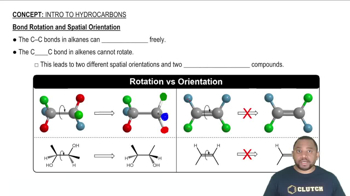
Bond Rotation and Rigidity

Bond rotation refers to the ability of atoms connected by a bond to rotate around that bond axis. Single bonds allow for free rotation due to less steric hindrance, while double bonds restrict rotation because of the presence of pi bonds, which create a planar structure. This rigidity impacts the overall shape and reactivity of molecules.
추천 영상:
가이드 코스
02:25
Bond Rotation and Spatial Orientation

Steric Hindrance

Steric hindrance is the repulsion between atoms that occurs when they are brought close together, affecting their ability to rotate around bonds. In the case of double bonds, the spatial arrangement of atoms creates more steric hindrance compared to single bonds, making it more difficult to twist or rotate around a double bond without breaking it.