Ch.9 - Molecular Geometry and Bonding Theories
Brown - Chemistry: The Central Science 14th Edition
Brown14th EditionChemistry: The Central ScienceISBN: 9780134414232당신이 사용하는 게 아니라요?교과서 변경
9장, 문제 55d

(d) Can two s orbitals combine to form a p bond? Explain.

검증된 단계별 안내
1
Understand the nature of atomic orbitals: s orbitals are spherical in shape, while p orbitals are dumbbell-shaped and have directional characteristics.
Recognize the types of bonds: Sigma (σ) bonds are formed by the head-on overlap of orbitals, while pi (π) bonds are formed by the side-to-side overlap of orbitals.
Consider the overlap possibilities: s orbitals can overlap with each other or with other orbitals to form sigma bonds due to their spherical symmetry.
Analyze the formation of pi bonds: Pi bonds require parallel, side-to-side overlap, which is characteristic of p orbitals, not s orbitals.
Conclude based on orbital characteristics: Since s orbitals lack the directional nature needed for side-to-side overlap, they cannot combine to form pi bonds.

비슷한 문제에 대한 검증된 영상 답변:

이 영상 해법은 위 문제에 도움이 된다고 튜터들이 추천한 것입니다.
영상 길이:
46s
도움이 되었나요?

주요 개념

질문에 올바르게 답하기 위해 반드시 이해해야 하는 핵심 개념들은 다음과 같습니다.

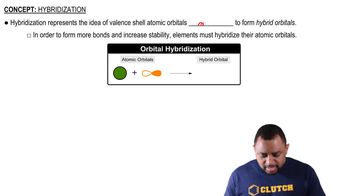
Orbital Hybridization

Orbital hybridization is the process by which atomic orbitals mix to form new hybrid orbitals that can accommodate bonding. In the context of s and p orbitals, hybridization allows for the formation of bonds that are stronger and more directional than those formed by the original atomic orbitals alone.
추천 영상:

Types of Chemical Bonds

Chemical bonds can be classified into sigma (σ) and pi (π) bonds. Sigma bonds are formed by the head-on overlap of orbitals, while pi bonds result from the side-to-side overlap of p orbitals. Understanding these types of bonds is crucial for determining how different orbitals can combine to form stable molecular structures.
추천 영상:

Orbital Overlap

Orbital overlap refers to the interaction between atomic orbitals when atoms approach each other to form a bond. For a bond to form, there must be sufficient overlap between the orbitals involved. In the case of s orbitals, they can only form sigma bonds due to their spherical shape, while p orbitals can form both sigma and pi bonds depending on their orientation.
추천 영상:
가이드 코스
03:06
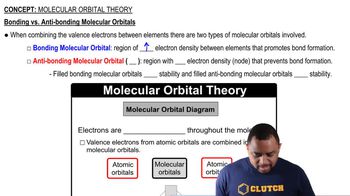
Molecular Orbital Theory