Ch.9 - Molecular Geometry and Bonding Theories
Brown - Chemistry: The Central Science 14th Edition
Brown14th EditionChemistry: The Central ScienceISBN: 9780134414232당신이 사용하는 게 아니라요?교과서 변경
9장, 문제 83a

Consider the molecular orbitals of the P2 molecule. Assume that the MOs of diatomics from the third row of the periodic table are analogous to those from the second row. (a) Which valence atomic orbitals of P are used to construct the MOs of P2?

검증된 단계별 안내
1
Identify the valence atomic orbitals of phosphorus (P). Phosphorus, being in the third period of the periodic table, has valence electrons in the 3s and 3p orbitals.
Understand the concept of molecular orbitals (MOs). MOs are formed by the linear combination of atomic orbitals (LCAO) from each atom in the molecule.
Recognize that the molecular orbitals in diatomic molecules like P2 are formed by the combination of similar orbitals from each phosphorus atom. This includes combinations of s orbitals with s orbitals, p orbitals with p orbitals, and possibly mixing between s and p orbitals.
Apply the analogy between second row and third row diatomic molecules. Since the molecular orbitals of O2 (a second row diatomic molecule) involve 2s and 2p orbitals, by analogy, the MOs of P2 will involve the 3s and 3p orbitals of each phosphorus atom.
Conclude that the valence atomic orbitals of phosphorus used to construct the MOs of P2 are the 3s and 3p orbitals.

비슷한 문제에 대한 검증된 영상 답변:

이 영상 해법은 위 문제에 도움이 된다고 튜터들이 추천한 것입니다.
영상 길이:
4m

주요 개념

질문에 올바르게 답하기 위해 반드시 이해해야 하는 핵심 개념들은 다음과 같습니다.

Molecular Orbitals (MOs)

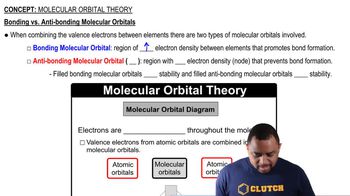
Molecular orbitals are formed by the linear combination of atomic orbitals (LCAO) when atoms bond together. In diatomic molecules, these MOs can be classified as bonding or antibonding, depending on whether they stabilize or destabilize the molecule. Understanding how atomic orbitals combine to form MOs is crucial for predicting the electronic structure and properties of molecules.
추천 영상:
가이드 코스
03:06
Molecular Orbital Theory

Valence Atomic Orbitals

Valence atomic orbitals are the outermost orbitals of an atom that participate in chemical bonding. For phosphorus (P), the relevant valence orbitals include the 3s and 3p orbitals. Identifying which of these orbitals contribute to the formation of MOs in a molecule like P2 is essential for understanding its bonding characteristics and molecular geometry.
추천 영상:
가이드 코스
01:51
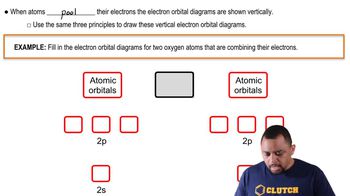
Atomic Orbitals Example

Periodic Trends in Orbital Energy

The energy levels and types of atomic orbitals can vary across periods in the periodic table. For elements in the third row, such as phosphorus, the energy and arrangement of orbitals are similar to those in the second row but with some differences due to increased nuclear charge and electron shielding. Recognizing these trends helps in predicting how atomic orbitals from different elements will interact when forming MOs.
추천 영상:
가이드 코스
01:08
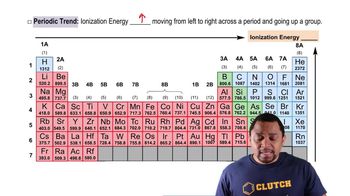
Ionization Energy Trends
관련 실천
교과서 질문

(c) With what neutral homonuclear diatomic molecules are the NO+ and NO- ions isoelectronic (same number of electrons)? With what neutral homonuclear diatomic molecule is the NO- ion isoelectronic (same number of electrons)?

1037
views

교과서 질문

(a) The nitric oxide molecule, NO, readily loses one electron to form the NO+ ion. Which of the following is the best explanation of why this happens: (i) Oxygen is more electronegative than nitrogen, (ii) The highest energy electron in NO lies in a π2p* molecular orbital, or (iii) The π2p* MO in NO is completely filled.

교과서 질문

The iodine bromide molecule, IBr, is an interhalogen compound. Assume that the molecular orbitals of IBr are analogous to the homonuclear diatomic molecule F2. (a) Which valence atomic orbitals of I and of Br are used to construct the MOs of IBr?

843
views
교과서 질문

Determine the electron configurations for CN+, CN, and CN-. (b) Which species, if any, has unpaired electrons?

2116
views
교과서 질문

Consider the molecular orbitals of the P2 molecule. Assume that the MOs of diatomics from the third row of the periodic table are analogous to those from the second row. (c) For the P2 molecule, how many electrons occupy the MO in the figure?

826
views
교과서 질문

The iodine bromide molecule, IBr, is an interhalogen compound. Assume that the molecular orbitals of IBr are analogous to the homonuclear diatomic molecule F2. (c) One of the valence MOs of IBr is sketched here. Why are the atomic orbital contributions to this MO different in size?

915
views