Ch.9 - Molecular Geometry and Bonding Theories
Brown - Chemistry: The Central Science 14th Edition
Brown14th EditionChemistry: The Central ScienceISBN: 9780134414232당신이 사용하는 게 아니라요?교과서 변경
9장, 문제 43c

Dichloroethylene (C2H2Cl2) has three forms (isomers), each of which is a different substance. (c) How many isomeric forms can chloroethylene, C2H3Cl, have? Would they be expected to have dipole moments?

검증된 단계별 안내
1
Identify the molecular formula of chloroethylene, which is C2H3Cl. This indicates that the molecule contains two carbon atoms, three hydrogen atoms, and one chlorine atom.
Consider the possible arrangements of atoms in the molecule. Since there are two carbon atoms, they can form a double bond, which is characteristic of ethylene derivatives.
Determine the possible positions for the chlorine atom. In chloroethylene, the chlorine atom can be attached to either of the carbon atoms, leading to different structural isomers.
Analyze the geometric arrangement of the atoms. The presence of a double bond between the carbon atoms restricts rotation, allowing for cis-trans isomerism. This means the chlorine atom can be on the same side (cis) or opposite sides (trans) of the double bond.
Evaluate the dipole moments of the isomers. The presence of a chlorine atom, which is more electronegative than carbon and hydrogen, will create a dipole moment. The magnitude and direction of the dipole moment will depend on the spatial arrangement of the atoms in each isomer.

비슷한 문제에 대한 검증된 영상 답변:

이 영상 해법은 위 문제에 도움이 된다고 튜터들이 추천한 것입니다.
영상 길이:
4m
도움이 되었나요?

주요 개념

질문에 올바르게 답하기 위해 반드시 이해해야 하는 핵심 개념들은 다음과 같습니다.

Isomerism

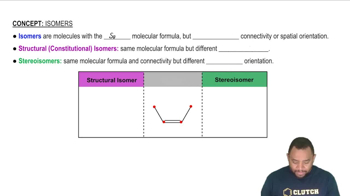
Isomerism refers to the phenomenon where two or more compounds have the same molecular formula but different structural arrangements or spatial orientations of atoms. In organic chemistry, isomers can be classified into structural isomers, which differ in the connectivity of atoms, and stereoisomers, which have the same connectivity but differ in the arrangement of atoms in space. Understanding isomerism is crucial for predicting the properties and reactivity of compounds.
추천 영상:
가이드 코스
2:14
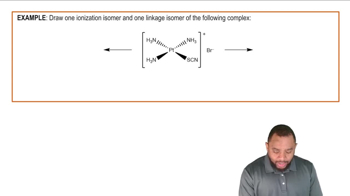
Isomerism in Coordination Complexes Example

Dipole Moment

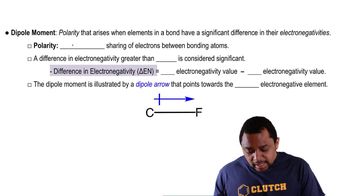
A dipole moment is a measure of the separation of positive and negative charges in a molecule, indicating its polarity. It arises when there is an uneven distribution of electron density, often due to differences in electronegativity between atoms. Molecules with significant dipole moments are polar and can interact with other polar substances, affecting their physical properties such as solubility and boiling points.
추천 영상:

Chloroethylene Isomers

Chloroethylene (C2H3Cl) can exist in multiple isomeric forms due to the presence of different arrangements of chlorine and hydrogen atoms around the carbon skeleton. The two main types of isomers for chloroethylene are structural isomers, which include vinyl chloride and other configurations, and geometric isomers, which may arise from restricted rotation around double bonds. The presence of these isomers can influence their chemical behavior and physical properties, including dipole moments.
추천 영상: