Ch.9 - Molecular Geometry and Bonding Theories
Brown - Chemistry: The Central Science 14th Edition
Brown14th EditionChemistry: The Central ScienceISBN: 9780134414232당신이 사용하는 게 아니라요?교과서 변경
9장, 문제 41

Predict whether each of the following molecules is polar or nonpolar: (a) IF, (b) CS2, (c) SO3, (d) PCl3, (e) SF6, (f) IF5.

검증된 단계별 안내
1
Determine the molecular geometry for each molecule using VSEPR theory.
Assess the electronegativity difference between the atoms in each molecule to identify polar bonds.
For each molecule, evaluate the symmetry of the molecular geometry to determine if the dipoles cancel out.
If the dipoles do not cancel out, the molecule is polar; if they do, the molecule is nonpolar.
Summarize the polarity of each molecule based on the analysis of bond polarity and molecular geometry.

비슷한 문제에 대한 검증된 영상 답변:

이 영상 해법은 위 문제에 도움이 된다고 튜터들이 추천한 것입니다.
영상 길이:
2m
도움이 되었나요?

주요 개념

질문에 올바르게 답하기 위해 반드시 이해해야 하는 핵심 개념들은 다음과 같습니다.

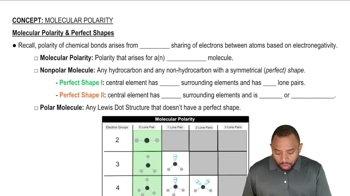
Molecular Polarity

Molecular polarity refers to the distribution of electrical charge across a molecule, which determines whether it has a positive or negative end. A molecule is polar if it has a significant difference in electronegativity between its atoms, leading to an uneven distribution of charge. Nonpolar molecules, on the other hand, have an even distribution of charge, often due to symmetrical arrangements of identical atoms or balanced dipoles.
추천 영상:
가이드 코스
02:38
Molecular Polarity

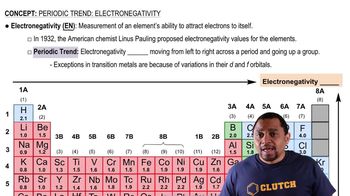
Electronegativity

Electronegativity is a measure of an atom's ability to attract and hold onto electrons in a chemical bond. The difference in electronegativity between two bonded atoms can indicate whether the bond is ionic, polar covalent, or nonpolar covalent. In general, larger differences in electronegativity (greater than 1.7) result in ionic bonds, while smaller differences (less than 1.7) can lead to polar or nonpolar covalent bonds.
추천 영상:
가이드 코스
02:10
Electronegativity Trends

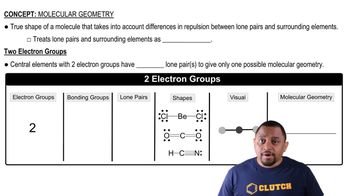
Molecular Geometry

Molecular geometry refers to the three-dimensional arrangement of atoms within a molecule. The shape of a molecule affects its polarity; for example, a symmetrical shape can lead to nonpolar characteristics even if the individual bonds are polar. Understanding the geometry, often predicted by VSEPR theory, is crucial for determining the overall polarity of a molecule, as it influences how dipoles from polar bonds interact.
추천 영상:
가이드 코스
01:33
Molecular Geometry with Two Electron Groups