Ch.9 - Molecular Geometry and Bonding Theories
Brown - Chemistry: The Central Science 14th Edition
Brown14th EditionChemistry: The Central ScienceISBN: 9780134414232당신이 사용하는 게 아니라요?교과서 변경
9장, 문제 80b

If we assume that the energy-level diagrams for homonuclear diatomic molecules shown in Figure 9.43 can be applied to heteronuclear diatomic molecules and ions, predict the bond order and magnetic behavior of (b) NO+.

검증된 단계별 안내
1
Identify the total number of valence electrons in the NO+ molecule. Nitrogen (N) has 5 valence electrons and Oxygen (O) has 6 valence electrons. Since the molecule is NO+ (positively charged), it means it has lost one electron, reducing the total count by one.
Calculate the total number of electrons in NO+. Add the valence electrons of N and O, then subtract one electron for the positive charge: 5 (from N) + 6 (from O) - 1 (charge) = 10 electrons.
Distribute these 10 electrons among the molecular orbitals. According to molecular orbital theory for diatomic molecules, electrons fill from the lowest energy orbital upwards. For NO+, the order typically starts with sigma 1s, sigma star 1s, sigma 2s, sigma star 2s, pi 2p (filling two degenerate pi orbitals simultaneously), sigma 2p, pi star 2p, and sigma star 2p.
Determine the bond order using the formula: Bond Order = (number of electrons in bonding orbitals - number of electrons in antibonding orbitals) / 2. Count the electrons in bonding and antibonding orbitals from the distribution you did in the previous step.
Predict the magnetic behavior by checking if there are unpaired electrons in the molecular orbitals. If there are unpaired electrons, the molecule is paramagnetic; if all electrons are paired, the molecule is diamagnetic.

비슷한 문제에 대한 검증된 영상 답변:

이 영상 해법은 위 문제에 도움이 된다고 튜터들이 추천한 것입니다.
영상 길이:
5m

주요 개념

질문에 올바르게 답하기 위해 반드시 이해해야 하는 핵심 개념들은 다음과 같습니다.

Bond Order

Bond order is a measure of the number of chemical bonds between a pair of atoms. It is calculated as the difference between the number of bonding and antibonding electrons divided by two. A higher bond order indicates a stronger bond and greater stability of the molecule. For diatomic molecules, bond order can help predict the bond strength and length.
추천 영상:
가이드 코스
00:36
Average Bond Order

Molecular Orbital Theory

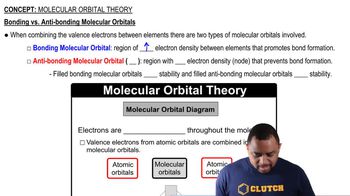
Molecular Orbital Theory describes the behavior of electrons in molecules using molecular orbitals, which are formed by the combination of atomic orbitals. Electrons occupy these orbitals according to the Aufbau principle, Pauli exclusion principle, and Hund's rule. This theory is essential for understanding the electronic structure of molecules, including their bond order and magnetic properties.
추천 영상:
가이드 코스
03:06
Molecular Orbital Theory

Magnetic Behavior

Magnetic behavior in molecules is determined by the presence of unpaired electrons in molecular orbitals. Molecules with unpaired electrons exhibit paramagnetism, being attracted to magnetic fields, while those with all electrons paired are diamagnetic and are repelled by magnetic fields. Understanding the electron configuration and molecular orbitals helps predict whether a molecule will be magnetic.
추천 영상:
가이드 코스
00:59
Magnetic Quantum Example