Ch.9 - Molecular Geometry and Bonding Theories
Brown - Chemistry: The Central Science 14th Edition
Brown14th EditionChemistry: The Central ScienceISBN: 9780134414232당신이 사용하는 게 아니라요?교과서 변경
9장, 문제 45

For each statement, indicate whether it is true or false. (a) In order to make a covalent bond, the orbitals on each atom in the bond must overlap. (b) A p orbital on one atom cannot make a bond to an s orbital on another atom.

검증된 단계별 안내
1
Step 1: Understand the concept of covalent bonding. Covalent bonds are formed when two atoms share electrons. This sharing occurs through the overlap of atomic orbitals, which allows the electrons to be shared between the atoms.
Step 2: Analyze statement (a). Consider the requirement for orbital overlap in covalent bonding. Since covalent bonds involve the sharing of electrons through overlapping orbitals, determine if the statement about the necessity of orbital overlap is true or false.
Step 3: Understand the types of orbitals involved in bonding. Orbitals such as s, p, d, and f can participate in bonding. The s orbital is spherical, while p orbitals are dumbbell-shaped, and they can overlap with each other or with other types of orbitals.
Step 4: Analyze statement (b). Consider whether a p orbital on one atom can overlap with an s orbital on another atom. Recall that different types of orbitals can indeed overlap to form bonds, such as the overlap between an s orbital and a p orbital, which is common in many molecules.
Step 5: Evaluate the truth of each statement based on your understanding of orbital overlap and bonding. Use your knowledge of how different orbitals can interact to determine the truth value of each statement.

주요 개념

질문에 올바르게 답하기 위해 반드시 이해해야 하는 핵심 개념들은 다음과 같습니다.

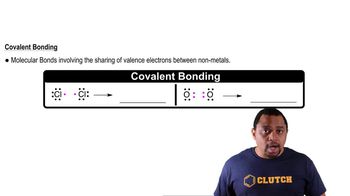
Covalent Bonding

Covalent bonding occurs when two atoms share one or more pairs of electrons, allowing each atom to attain a stable electron configuration. This sharing typically involves the overlap of atomic orbitals, which can include s, p, and d orbitals, depending on the atoms involved. The strength and characteristics of the bond depend on the extent of this overlap.
추천 영상:

Orbital Overlap

Orbital overlap is a fundamental concept in covalent bonding, where the atomic orbitals of two atoms intersect, allowing for the sharing of electrons. The greater the overlap, the stronger the bond formed. This principle is crucial for understanding how different types of orbitals (s, p, d) can interact to form stable molecules.
추천 영상:
가이드 코스
03:06
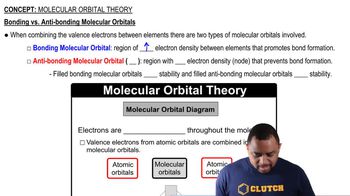
Molecular Orbital Theory

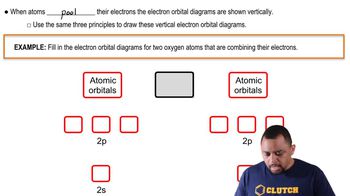
Types of Atomic Orbitals

Atomic orbitals are regions in an atom where there is a high probability of finding electrons. The main types include s orbitals (spherical) and p orbitals (dumbbell-shaped). While p orbitals can indeed overlap with s orbitals to form covalent bonds, the specific orientation and energy levels of the orbitals involved can influence the bond's characteristics.
추천 영상:
가이드 코스
01:51
Atomic Orbitals Example