

Ch.9 - Molecular Geometry and Bonding Theories
Brown - Chemistry: The Central Science 14th Edition
Brown14th EditionChemistry: The Central ScienceISBN: 9780134414232당신이 사용하는 게 아니라요?교과서 변경
9장, 문제 114a

Sulfur tetrafluoride 1SF42 reacts slowly with O2 to form sulfur tetrafluoride monoxide 1OSF42 according to the following unbalanced reaction: SF41g2 + O21g2¡OSF41g2 The O atom and the four F atoms in OSF4 are bonded to a central S atom. (a) Balance the equation.

검증된 단계별 안내
1
Step 1: Identify the reactants and products in the chemical reaction. In this case, the reactants are sulfur tetrafluoride (SF4) and oxygen (O2), and the product is sulfur tetrafluoride monoxide (OSF4).
Step 2: Start by balancing the atoms that appear in the most complex molecules first. In this case, we start with sulfur (S) and fluorine (F). Since there is one S atom in both the reactants and products, it is already balanced. For F, there are 4 atoms in both the reactants and products, so it is also balanced.
Step 3: Next, balance the oxygen (O) atoms. There are 2 O atoms in the reactant (O2) and 1 O atom in the product (OSF4). To balance this, we need to put a coefficient of 1/2 in front of O2 in the reactants.
Step 4: However, in chemical equations, we avoid fractional coefficients. Therefore, to get rid of the 1/2, we multiply all the coefficients by 2. This gives us 2SF4 + O2 → 2OSF4.
Step 5: Finally, check to make sure that the equation is balanced by counting the atoms of each element on both sides of the equation. There should be the same number of each type of atom on the reactant side as there is on the product side.

비슷한 문제에 대한 검증된 영상 답변:

이 영상 해법은 위 문제에 도움이 된다고 튜터들이 추천한 것입니다.
영상 길이:
59s

주요 개념

질문에 올바르게 답하기 위해 반드시 이해해야 하는 핵심 개념들은 다음과 같습니다.

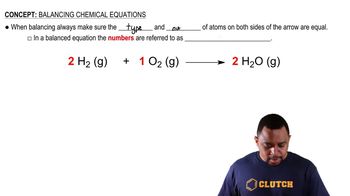
Balancing Chemical Equations

Balancing chemical equations involves ensuring that the number of atoms of each element is the same on both sides of the equation. This is achieved by adjusting the coefficients in front of the chemical formulas. The law of conservation of mass dictates that matter cannot be created or destroyed in a chemical reaction, thus requiring balanced equations to accurately represent the reaction.
추천 영상:
가이드 코스
01:32
Balancing Chemical Equations

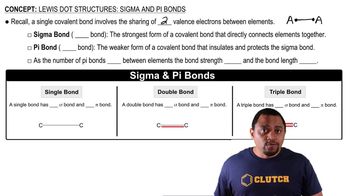
Molecular Structure and Bonding

Understanding molecular structure and bonding is crucial for predicting how molecules interact during a reaction. In the case of sulfur tetrafluoride monoxide (OSF4), the central sulfur atom is bonded to one oxygen atom and four fluorine atoms, which influences the molecule's reactivity and the overall reaction mechanism. Knowledge of molecular geometry can also aid in visualizing how these atoms are arranged.
추천 영상:
가이드 코스
03:26
Lewis Dot Structures: Sigma & Pi Bonds

Stoichiometry

Stoichiometry is the quantitative relationship between reactants and products in a chemical reaction. It allows chemists to calculate the amounts of substances consumed and produced, based on the balanced equation. In this context, stoichiometry will help determine the correct coefficients needed to balance the reaction between sulfur tetrafluoride and oxygen, ensuring that the proportions of reactants and products are accurately represented.
추천 영상:
가이드 코스
01:16
Stoichiometry Concept
관련 실천
교과서 질문

Sulfur tetrafluoride (SF4) reacts slowly with O2 to form sulfur tetrafluoride monoxide (OSF4) according to the following unbalanced reaction: SF4(g) + O2(g) → OSF4(g) The O atom and the four F atoms in OSF4 are bonded to a central S atom. (c) Use average bond enthalpies (Table 8.3) to estimate the enthalpy of the reaction. Is it endothermic or exothermic?

688
views
교과서 질문

Sulfur tetrafluoride (SF4) reacts slowly with O2 to form sulfur tetrafluoride monoxide (OSF4) according to the following unbalanced reaction: SF4(g) + O2(g) → OSF4(g) The O atom and the four F atoms in OSF4 are bonded to a central S atom. (b) Write a Lewis structure of OSF4 in which the formal charges of all atoms are zero.

400
views
교과서 질문

Sulfur tetrafluoride 1SF42 reacts slowly with O2 to form sulfur

tetrafluoride monoxide 1OSF42 according to the following

unbalanced reaction:

SF41g2 + O21g2¡OSF41g2

The O atom and the four F atoms in OSF4 are bonded to a

central S atom.

(e) For each of the molecules you drew in part (d), state how many

fluorines are equatorial and how many are axial.

102
views
교과서 질문

The energy-level diagram in Figure 9.36 shows that the sideways overlap of a pair of p orbitals produces two molecular orbitals, one bonding and one antibonding. In ethylene there is a pair of electrons in the bonding π orbital between the two carbons. Absorption of a photon of the appropriate wavelength can result in promotion of one of the bonding electrons from the p2p to the p*2p molecular orbital. (c) Is the C¬C bond in ethylene stronger or weaker in the excited state than in the ground state? Why?

510
views