
Ch.9 - Molecular Geometry and Bonding Theories
Brown - Chemistry: The Central Science 14th Edition
Brown14th EditionChemistry: The Central ScienceISBN: 9780134414232당신이 사용하는 게 아니라요?교과서 변경
9장, 문제 114b

Sulfur tetrafluoride (SF4) reacts slowly with O2 to form sulfur tetrafluoride monoxide (OSF4) according to the following unbalanced reaction: SF4(g) + O2(g) → OSF4(g) The O atom and the four F atoms in OSF4 are bonded to a central S atom. (b) Write a Lewis structure of OSF4 in which the formal charges of all atoms are zero.

검증된 단계별 안내
1
Identify the total number of valence electrons in OSF_4. Sulfur (S) has 6 valence electrons, oxygen (O) has 6, and each fluorine (F) has 7. Therefore, the total is 6 (S) + 6 (O) + 4 * 7 (F) = 40 valence electrons.
Place the sulfur (S) atom in the center, as it is the least electronegative element, and arrange the oxygen (O) and four fluorine (F) atoms around it.
Draw single bonds between the central sulfur atom and each of the surrounding atoms (O and F). This uses up 5 bonds * 2 electrons/bond = 10 electrons.
Distribute the remaining 30 electrons to satisfy the octet rule for the surrounding atoms, starting with the more electronegative atoms (O and F). Each F atom should have 6 more electrons to complete its octet, using 24 electrons in total.
Assign the remaining electrons to the central sulfur atom. Check the formal charges: S should have 0 formal charge with 6 electrons around it, O should have 0 formal charge with 8 electrons around it, and each F should have 0 formal charge with 8 electrons around it.

비슷한 문제에 대한 검증된 영상 답변:

이 영상 해법은 위 문제에 도움이 된다고 튜터들이 추천한 것입니다.
영상 길이:
2m

주요 개념

질문에 올바르게 답하기 위해 반드시 이해해야 하는 핵심 개념들은 다음과 같습니다.

Lewis Structures

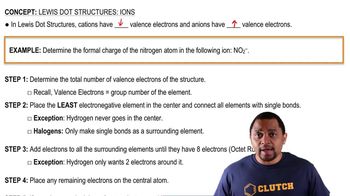
Lewis structures are diagrams that represent the bonding between atoms in a molecule and the lone pairs of electrons that may exist. They help visualize the arrangement of electrons and the connectivity of atoms, allowing chemists to predict molecular geometry and reactivity. In constructing a Lewis structure, one must account for the total number of valence electrons and ensure that each atom achieves a stable electron configuration, typically resembling that of noble gases.
추천 영상:
가이드 코스
04:28
Lewis Dot Structures: Ions

Formal Charge

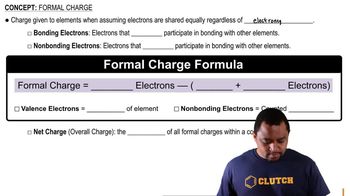
Formal charge is a concept used to determine the distribution of electrons in a molecule. It is calculated by taking the number of valence electrons in an atom, subtracting the number of non-bonding electrons, and half the number of bonding electrons. A formal charge of zero on all atoms in a molecule is often desirable, as it indicates a more stable structure. Understanding formal charges is crucial for drawing accurate Lewis structures and predicting molecular stability.
추천 영상:

Molecular Geometry

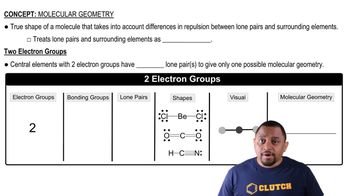
Molecular geometry refers to the three-dimensional arrangement of atoms within a molecule. It is influenced by the number of bonding pairs and lone pairs of electrons around the central atom, which can affect the molecule's shape and properties. The VSEPR (Valence Shell Electron Pair Repulsion) theory is commonly used to predict molecular geometry, helping to understand how the arrangement of atoms can impact reactivity and interactions with other molecules.
추천 영상:
가이드 코스
01:33
Molecular Geometry with Two Electron Groups