Ch.9 - Molecular Geometry and Bonding Theories
Brown - Chemistry: The Central Science 14th Edition
Brown14th EditionChemistry: The Central ScienceISBN: 9780134414232당신이 사용하는 게 아니라요?교과서 변경
9장, 문제 9e

The molecule shown below is called furan. It is represented in typical shorthand way for organic molecules, with hydrogen atoms not shown, and each of the 4 vertices representing a carbon atom.
Chemical structure of thiophene, a five-membered ring with sulfur, relevant to hybridization in furan.
(e) The C—C—C bond angles in furan are much smaller than those in benzene. The likely reason is which of the following: (i) The hybridization of the carbon atoms in furan is different from that in benzene, (ii) Furan does not have another resonance structure equivalent to the one above, or (iii) The atoms in a five-membered ring are forced to adopt smaller angles than in a six-membered ring.

검증된 단계별 안내
1
Identify the structure of furan and compare it to the structure of benzene.
Note that furan is a five-membered ring with an oxygen atom, while benzene is a six-membered ring with all carbon atoms.
Understand that the bond angles in a regular hexagon (benzene) are 120 degrees due to sp2 hybridization of carbon atoms.
Recognize that in a five-membered ring like furan, the bond angles are smaller because the ring is more strained compared to a six-membered ring.
Conclude that the smaller bond angles in furan are primarily due to the ring strain in a five-membered ring, making option (iii) the most likely reason.

비슷한 문제에 대한 검증된 영상 답변:

이 영상 해법은 위 문제에 도움이 된다고 튜터들이 추천한 것입니다.
영상 길이:
3m
도움이 되었나요?

주요 개념

질문에 올바르게 답하기 위해 반드시 이해해야 하는 핵심 개념들은 다음과 같습니다.

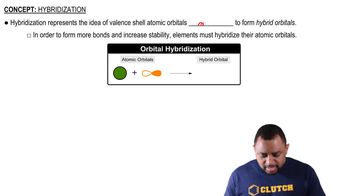
Hybridization

Hybridization is the concept of mixing atomic orbitals to form new hybrid orbitals that can accommodate the bonding requirements of atoms in a molecule. In furan, the carbon atoms are typically sp2 hybridized, allowing for the formation of a planar structure with bond angles around 120 degrees. This differs from benzene, where the carbon atoms are also sp2 hybridized but are arranged in a six-membered ring, leading to different bond angles.
추천 영상:

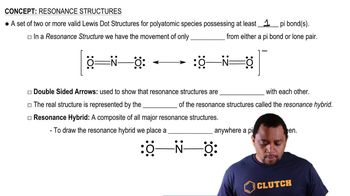
Resonance Structures

Resonance structures are different ways of drawing a molecule that represent the same arrangement of atoms but differ in the distribution of electrons. Furan has resonance structures that contribute to its stability, while benzene has a highly symmetrical resonance structure that allows for equal bond lengths. The presence or absence of resonance structures can influence the bond angles and overall geometry of the molecule.
추천 영상:
가이드 코스
01:42
Resonance Structures

Ring Strain

Ring strain refers to the increased energy and instability that occurs in cyclic compounds due to bond angles deviating from their ideal values. In five-membered rings like furan, the bond angles are typically smaller than the ideal tetrahedral angle of 109.5 degrees, leading to strain. This contrasts with six-membered rings like benzene, which can adopt bond angles closer to the ideal, resulting in lower strain and greater stability.
추천 영상:
가이드 코스
01:21
Chelating Agents