Ch.16 - Acid-Base Equilibria
Brown - Chemistry: The Central Science 15th Edition
Brown15th EditionChemistry: The Central ScienceISBN: 9780137542970당신이 사용하는 게 아니라요?교과서 변경
16장, 문제 12b

Consider the molecular models shown here, where X represents a halogen atom. (b) Does the acidity of each molecule increase or decrease as the electronegativity of the atom X increases?

검증된 단계별 안내
1
Identify the relationship between electronegativity and acidity. Generally, as electronegativity increases, the ability of an atom to attract electrons increases, which can affect acidity.
Consider the role of the halogen atom X in the molecule. A more electronegative halogen will pull electron density away from the rest of the molecule, potentially stabilizing the negative charge on the conjugate base after the acid donates a proton.
Recall that the stability of the conjugate base is a key factor in determining the strength of an acid. A more stable conjugate base corresponds to a stronger acid.
Analyze how the increased electronegativity of X affects the stability of the conjugate base. If X is more electronegative, it can better stabilize the negative charge, making the conjugate base more stable.
Conclude that as the electronegativity of the halogen atom X increases, the acidity of the molecule is likely to increase due to the increased stability of the conjugate base.

비슷한 문제에 대한 검증된 영상 답변:

이 영상 해법은 위 문제에 도움이 된다고 튜터들이 추천한 것입니다.
영상 길이:
50s
도움이 되었나요?

주요 개념

질문에 올바르게 답하기 위해 반드시 이해해야 하는 핵심 개념들은 다음과 같습니다.

Electronegativity

Electronegativity is a measure of an atom's ability to attract and hold onto electrons in a chemical bond. In the context of halogens, as electronegativity increases, the atom's ability to stabilize negative charge also increases, which can influence the acidity of the molecule. Higher electronegativity typically leads to stronger bonds with hydrogen, affecting the molecule's tendency to donate protons.
추천 영상:
가이드 코스
02:10
Electronegativity Trends

Acidity

Acidity refers to the ability of a substance to donate protons (H⁺ ions) in a solution. The strength of an acid is often determined by the stability of the conjugate base formed after the proton is lost. In the case of halogen-containing acids, the more electronegative the halogen, the more stable the conjugate base, which generally results in increased acidity.
추천 영상:

Conjugate Base Stability

The stability of a conjugate base is crucial in determining the strength of an acid. A more stable conjugate base is less likely to re-accept a proton, thus favoring the dissociation of the acid. In halogen acids, as the electronegativity of the halogen increases, the conjugate base becomes more stable due to the effective delocalization of negative charge, leading to increased acidity.
추천 영상:
가이드 코스
00:50
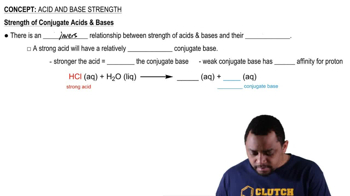
Strength of Conjugate Acids and Bases
관련 실천
교과서 질문

Consider the molecular models shown here, where X represents a halogen atom. (a) If X is the same atom in both molecules, which molecule will be more acidic?

415
views

교과서 질문

Which of the following statements is false? (a) An Arrhenius base increases the concentration of OH- in water. (b) A Brønsted-Lowry base is a proton acceptor. (c) Water can act as a Brønsted–Lowry acid. (d) Water can act as a Brønsted–Lowry base. (e) Any compound that contains an –OH group acts as a Brønsted-Lowry base.

519
views
교과서 질문

NH31g2 and HCl(g) react to form the ionic solid NH4Cl1s2. Which substance is the Brønsted–Lowry acid in this reaction? Which is the Brønsted–Lowry base?

361
views
교과서 질문

Phenylephrine, an organic substance with molecular formula C9H13NO2, is used as a nasal decongenstant in over-thecounter medications. The molecular structure of phenylephrine is shown below using the usual shortcut organic structure. (a) Would you expect a solution of phenylephrine to be acidic, neutral, or basic?

943
views
교과서 질문

Identify the Lewis acid and Lewis base among the reactants in each of the following reactions:

(a) Fe(ClO4)3(s) + 6 H2O(l) ⇌ [Fe(H2O)6]3+(aq) + 3 ClO4-(aq)

(b) CN-(aq) + H2O(l) ⇌ HCN(aq) + OH-(aq)

(c) (CH3)3N(g) + BF3(g) ⇌ (CH3)NBF3(s)

(d) HIO(lq) + NH2-(lq) ⇌ NH3(lq) + IO-(lq) (lq denotes liquid ammonia as solvent)

474
views
교과서 질문

Phenylephrine, an organic substance with molecular formula C9H13NO2, is used as a nasal decongenstant in over-thecounter medications. The molecular structure of phenylephrine is shown below using the usual shortcut organic structure. (c) Would you expect a solution of phenylephrine hydrochloride to be acidic, neutral, or basic?

428
views