
Ch.5 - Thermochemistry
Brown - Chemistry: The Central Science 15th Edition
Brown15th EditionChemistry: The Central ScienceISBN: 9780137542970당신이 사용하는 게 아니라요?교과서 변경
5장, 문제 16

Use the equations given in Problem 5.15 to calculate: (a) The electrostatic force of repulsion for two electrons separated by 75 pm. (b) The gravitational force of attraction for two electrons separated by 75 pm. (c) If allowed to move, will the electrons be repelled or attracted to one another?

검증된 단계별 안내
1
Step 1: Identify the relevant equations for calculating forces. For electrostatic force, use Coulomb's Law: \( F_e = \frac{k \cdot |q_1 \cdot q_2|}{r^2} \), where \( k \) is Coulomb's constant, \( q_1 \) and \( q_2 \) are the charges of the electrons, and \( r \) is the separation distance. For gravitational force, use Newton's Law of Universal Gravitation: \( F_g = \frac{G \cdot m_1 \cdot m_2}{r^2} \), where \( G \) is the gravitational constant, and \( m_1 \) and \( m_2 \) are the masses of the electrons.
Step 2: Substitute the known values into Coulomb's Law. The charge of an electron \( q \) is approximately \(-1.602 \times 10^{-19} \) C, and the separation distance \( r \) is 75 pm, which needs to be converted to meters (1 pm = \( 10^{-12} \) m).
Step 3: Substitute the known values into Newton's Law of Universal Gravitation. The mass of an electron \( m \) is approximately \( 9.109 \times 10^{-31} \) kg, and use the same separation distance \( r \) as in Step 2.
Step 4: Calculate the electrostatic force \( F_e \) using the substituted values in Coulomb's Law. This will give you the magnitude of the repulsive force between the two electrons.
Step 5: Calculate the gravitational force \( F_g \) using the substituted values in Newton's Law of Universal Gravitation. Compare the magnitudes of \( F_e \) and \( F_g \) to determine whether the electrons will be repelled or attracted.

주요 개념

질문에 올바르게 답하기 위해 반드시 이해해야 하는 핵심 개념들은 다음과 같습니다.

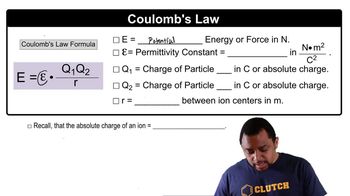
Coulomb's Law

Coulomb's Law describes the electrostatic force between two charged particles. It states that the force is directly proportional to the product of the magnitudes of the charges and inversely proportional to the square of the distance between them. This law is essential for calculating the electrostatic force of repulsion between two electrons, which both carry a negative charge.
추천 영상:
가이드 코스
01:15
Coulomb's Law Concept 2

Newton's Law of Universal Gravitation

Newton's Law of Universal Gravitation states that every mass attracts every other mass with a force that is proportional to the product of their masses and inversely proportional to the square of the distance between their centers. This principle is crucial for calculating the gravitational force of attraction between two electrons, despite their minuscule mass compared to the electrostatic forces at play.
추천 영상:
가이드 코스
01:42
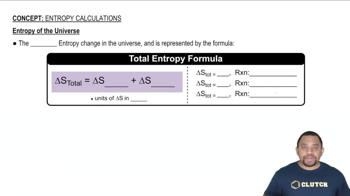
Entropy of the Universe

Nature of Electric and Gravitational Forces

Electric forces can be either attractive or repulsive depending on the charges involved, while gravitational forces are always attractive. In the case of two electrons, the electrostatic force will cause them to repel each other due to their like charges, while the gravitational force, although present, is negligible in comparison. Understanding this distinction is key to predicting the behavior of the electrons when allowed to move.
추천 영상:
가이드 코스
01:14
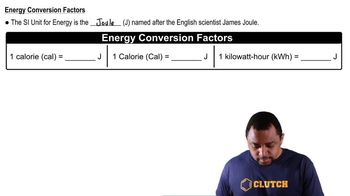
Nature of Energy